This article/blog post was written and published by Linden Alexander Pentecost, and was published on the 11th of February 2026. This article/blog post is published only on this website, and this article/blog post is unrelated to any and all of my other publications. This article was published in the UK, on this UK website, and the author is also from the UK and lives in the UK. No AI was used in this article. The photos in this article were taken by myself the author, one of them showing beautiful light at a stone ship megalithic site on Öland off the coast of Sweden, with cup marks on the stope, the second photo showing the Priapus Stone and its very similar cup marks at Great Urswick in Cumbria, England, and the third photo showing a different possible cup mark site. Whilst the main text contains a lot of other information, the descriptions in Italics above each photo contain information not in the main text, and like the photos and main text are important. The photos in this article/blog post have also not been published elsewhere, just as the written content has not been. This article/blog post contains a total of 1373 words.
Cup markings are prehistoric indentations found in parts of northwestern Europe, and nobody knows the exact reason for why they were created, but they are found widely. I have written unrelated things about them elsewhere, and have shared some theories of my own, and I will share some very interesting new information and ideas in this article/blog post on this page, but I think also that I need to look into which other indigenous cultures create similar markings in other parts of the world, and to try and understand what they mean.
One really interesting thing is how similar markings are described in some Lancashire dialects as Fairy finger marks. According to what I have read in source (1) given below this paragraph, Fairy finger marks in the Lonsdale dialect refers to "Hollow marks in limestone, as if fingers had been pressed upon the stones when soft" (1). This quote is taken from source (1) which is: A glossary of the dialect of the hundred of Lonsdale, north and south of the sands, in the county of Lancaster. by Robert Backhouse Peacock.
Whilst the quote given in the previous paragraph does not refer specifically to cup marks, I would imagine that cup marks would have come under the category and description of the Lancashire dialect noun: Fairy finger marks. It is also very interesting that the quote in the previous paragraph implies an idea that these markings were seen as though fairies pressed their fingers upon stone when soft, causing these markings. This is really fascinating too because it relates to a wider idea found in many indigenous cultures that the rocks of the world were at one time softer and more malleable in a previous age or time period. This does I think, to me at least, imply a belief that the Fairies in Lancashire were regarded as an ancient magical people, and connected to ancient people, similarly to how one of the caves known as Fairy Hole in Lancashire is also a prehistoric burial site. Could these ancient, magical peoples, be connected to cup marks specifically in a more general way? And could they connect to the ancestors who taught the ritual of the Priapus Stone at Great Urswick with cup marks, and to those who created a similar cup-marked, woman-shaped standing stone and placed it at a megalithic ship burial on Öland in Sweden? The photo descriptions above the photos below will shed more light on this I hope, as will the photos themselves, after the second of which is another photo description and photo below it, regarding a different site, this one a possible cup-mark site on a flat area of stone.
Photo below: incredible evening light shining over an ancient ship-shaped arrangement of standing stones, at Gettlinge Gravfält on the island of Öland off the southeastern coast of Sweden. The larger megalith on the left of the image, shining in amber evening light, is larger than the rest, and appears to represent the bow of this stone ship. Near the top of the "bow stone" on the left of the image can also be seen an assortment of cup marks, which look similar to those on the Priapus Stone at Urswick in Cumbria, shown in the next photo in this article, after the photo below and its description.
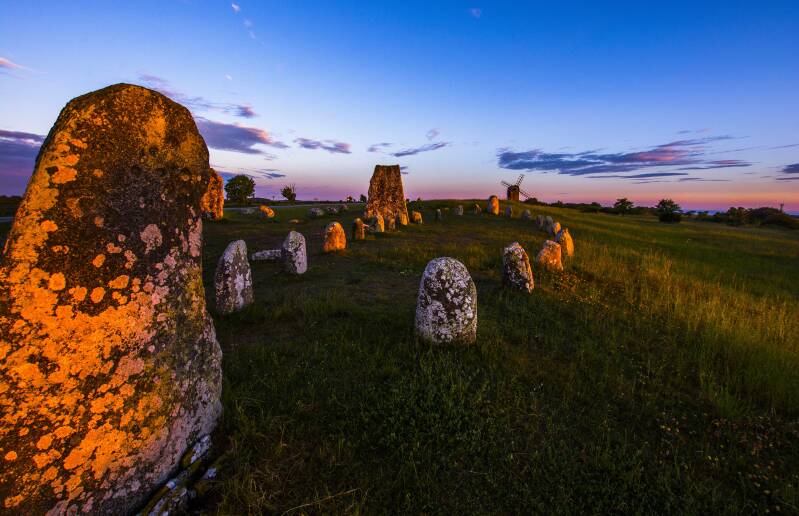
Photo below: a wall in Great Urswick, Cumbria, into the lower section of which has been incorporated a standing stone, known as the Priapus Stone, named after Priapus, a Greek fertility god. When this stone was in the past situated and upright in a nearby field, before sadly being incorporated into this wall, it was a part of the local spirituality up until the 19th century. At midsummer, people would "dress" this stone, by covering it with saliva, butter or tar, and then sticking rags of various colours into the stone. This seems I think to have been a part of a fertility ritual, and were it upright, it would also appear like an adult human in its shape, with the head of the stone figure facing upwards at the left end of the stone as visible in the photo below. To me the stone's shape is that of a tall woman. What is also noteworthy I think about the Priapus Stone at Great Urswick, are the five cup marks on the face of the stone face of the figure. This is of course very interesting given then the similarity that the Priapus Stone at Great Urswick bares to the "bow stone" of the stone ship megalithic site visible in the photo above this paragraph. Both stones also I think have women's figure shapes, and also contain a small, specific array of cup marks at the heads of the stones. Does this indicate in some way that the cultural and ritual understandings of the two stones at these two sites could be related in some more profound way?
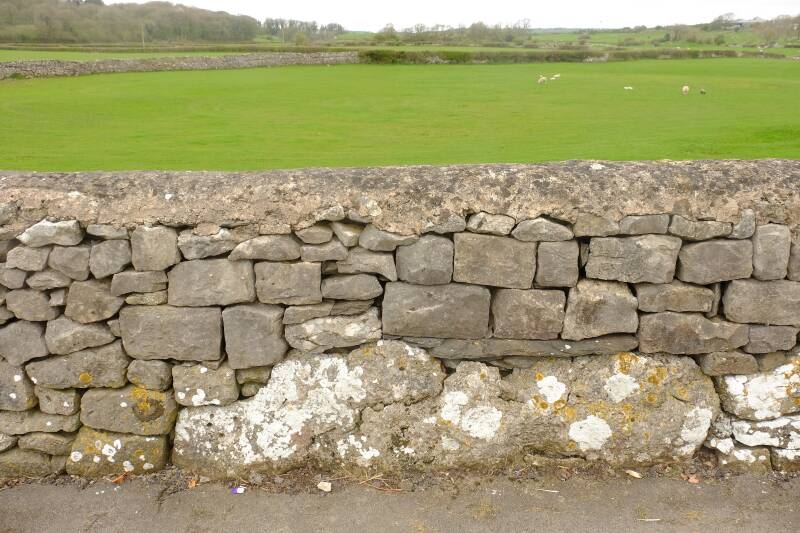
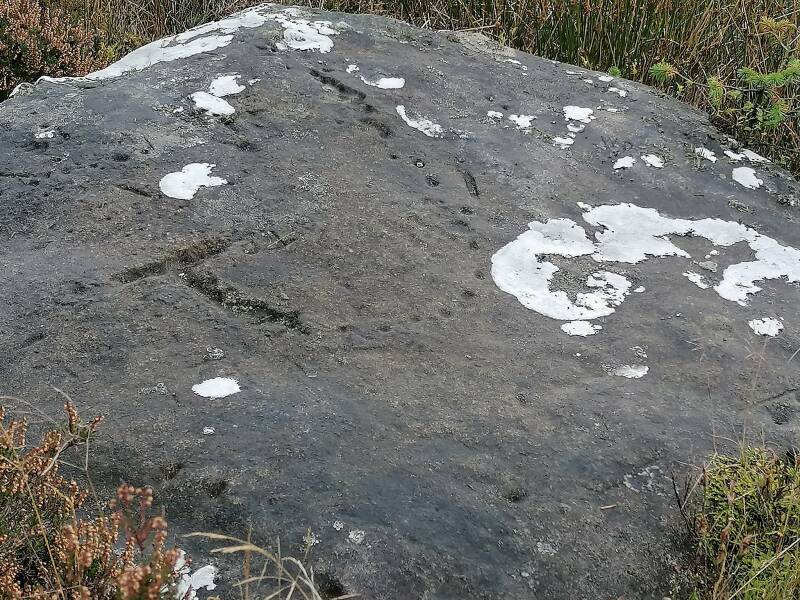
Photo below: a "possible" example of cup marks, located close to Christianbury Crags in North Cumbria, in the Kershope Forest. The example below, if I am correct, is around the coordinates 55°07'36.8"N 2°40'26.4"W . I am not sure if the example shown in the photo below is actually cup marks of ancient origin, which form a sort of inverted J shape, with the upper part of the semicircle-like like of cup-marks ending in a sort of J or T. Could this be recent or ancient? I am not entirely sure if the GPS coordinates I have given are absolutely correct or not, but I can say that this slab is visible on the right side of what was at least a footpath going straightly and steeply up towards Christianbury Crags from what I think is the general area of what I have given the coordinates as. I am not usually so vague with coordinates and grid references, but I had not really thought about this possible example since I took the photo in autumn 2021, until talking about it and including a photo of it in this blog post/article that is. Christianbury Crags itself is a very interesting site I have not discussed a lot elsewhere, and it itself contains many strange rock formations, although unlike at other similar sites I have discussed and published about elsewhere, I suspect that Christianbury Crag's curious features may mostly be just natural and geological, but this is something else I could potentially discuss more in the future.
I hope that this article was an interesting read, note I have published many unrelated more things recently on this and on other websites, including yesterday and the day before. This article/blog post on this page is dedicated to the ancestral people who were known by the title Fairy in Lancashire dialect, and to the wisdom keepers of cup-marks in general & is also written in honour of my grandad. Thank you.
Add comment
Comments
Hi there
I'm originally from the Lancashire area, and I've been fascinated by ancient rock art for most of my life. A few years ago, I chanced upon a proposed explanation that has been a revelation to me. I'd like to share it with you in the hope that it strikes a chord with you too.
My main interest in this subject has always been from an artistic, cultural and spiritual perspective. However, despite a lifetime reading about those aspects of ancient rock art, it now seems that the explanation is to be found in the field of cutting-edge scientific discoveries.
I'm a retired graphic designer, and physics has never been my specialist subject, but I believe that's where the answer really lies. In particular, relatively recent discoveries in the study of electromagnetic plasma phenomena have opened a window into past events that our ancestors witnessed and recorded.
As I understand matters, numerous kinds of enigmatic rock art images are actually accurate depictions of specific types of electromagnetic plasma phenomena that have been seen in pioneering laboratory experiments.
The cup and ring designs are just one of these ancient artworks that can now be understood to be historical records of celestial displays that were often strikingly beautiful. But these phenomena also featured deadly radiation at times.
Little wonder that humans (all around the globe) must have expended a great deal of time and energy to try to capture these events for posterity. Very few written records have survived from so far back in history, and so the ancient artworks have been the only "language" that has recorded the events in detail. And that "language" only became properly understood in the past few decades by plasma scientists at Los Alamos National Laboratory (USA).
When leading plasma physicist, Anthony Peratt, became aware of the link between ancient rock art and his scientific discoveries, he set out on a mammoth project to record it all. The link below is to one of his publications that sets out some of this scientific and artistic evidence.
I don't claim to understand (let alone explain) the complex scientific side of his work, but I'm sure that his discoveries are the correct explanation for the great enogma of ancient rock art imagery.
https://www.apanarcheo.nl/aurora%20jadeiet/PerattZpinch%20plasmaexperimenten.pdf