Written and published by Linden Alexander Pentecost, photos also by Linden Alexander Pentecost. This blog post contains 968 words & 4 photos. This blog post/article was lengthened significantly shortly after first being published, although this article is still much shorter than the majority of my other works but nevertheless contains a lot of important written content, and the four photos are also relevant.
Farleton Fell and the nearby Hutton Roof Crags are an area of limestone scar and limestone pavement, located not far from Beetham in southern Cumbria. I have been on these fells a few times and have discussed another known prehistoric site on there in a different publication, published on a different website, titled: m2. An example of a propped stone in Northern England, related linguistic points & other points
In this article on this page however I will discuss some other possible ancient structures on these limestone upland areas, as shown in the photos and discussed in the descriptions above the photos in this blog post.
Like certain other upland limestone areas in the north, parts of these limestone pavements contain features that are sometimes archaeological, and sometimes not obviously natural nor constructed by ancestors. On Farleton Fell there are propped stones, what look like rows of stones in places, and also the structures I show in this article, seemingly formed from single erratics, broken, and then placed against each other in a way that could not I think have formed naturally. Some structures are also made of several different stones and not of parts of the same original stone. The structures at Tongue Gill I discussed in another blog post recently, also seem to be formed of different stones and not of the same stones having been broken into two.
Farleton Fell does not however seem to possess the same forms of archaeological evidence showing cultures like those in upland Northern Yorkshire and in the Upper Eden in the Neolithic, Bronze and Iron Ages, and I wonder if perhaps the ancient cultures connected to Farleton Fell could have been and maintained a more Mesolithic or Upper Paleolithic culture. I also think it possible that some of these stone settings are of a very early time period.
The continuation of this article's main text with much more written text is after the photo descriptions and photos below, and begins after the fourth photo.
Photo below: a possible stone setting of some kind although it is also possible that this was an erratic which was deliberately broken to make this structure.
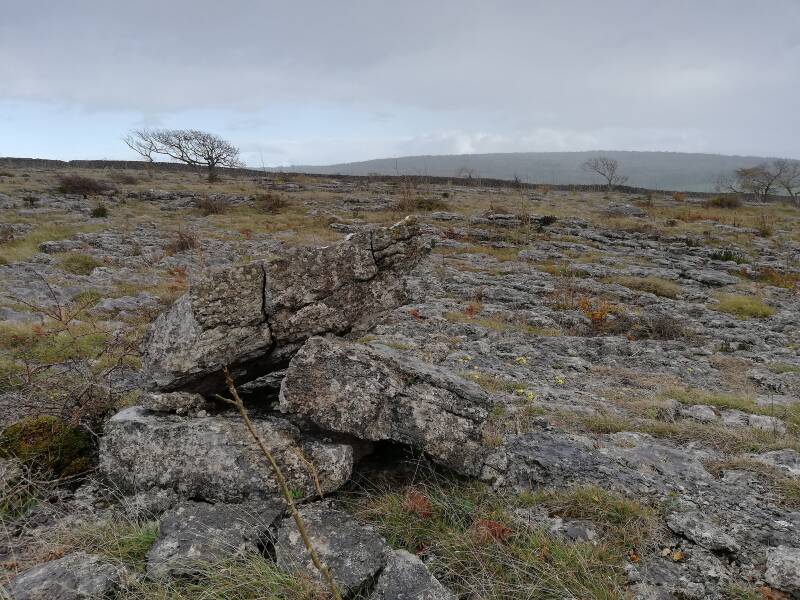
Photo below: another possible stone setting, note the face on the stone to the right. This again could have been formed by breaking a single erratic, but the position of the two stones does not to me suggest that they were placed like that naturally, even if they were once the same stone.
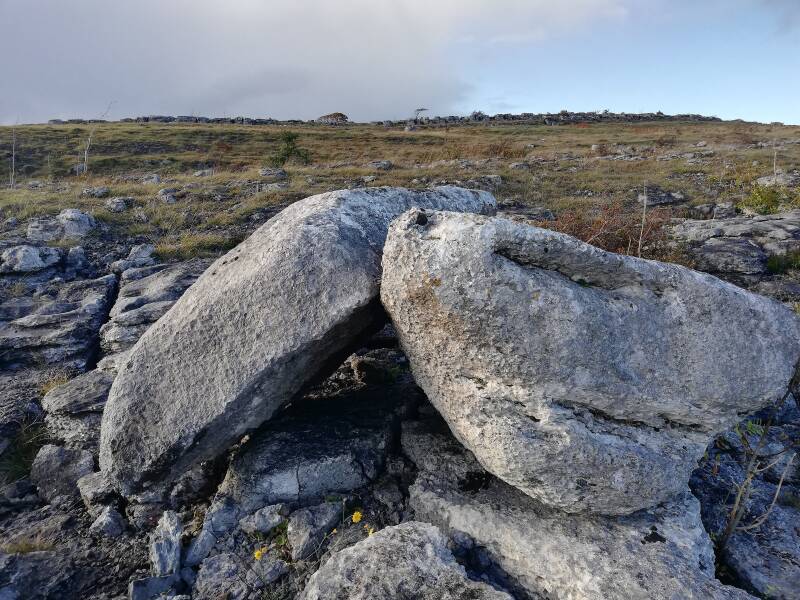
Photo below: another possible arrangement of stones, having perhaps been originally a single erratic that was broken by ancestral hands.
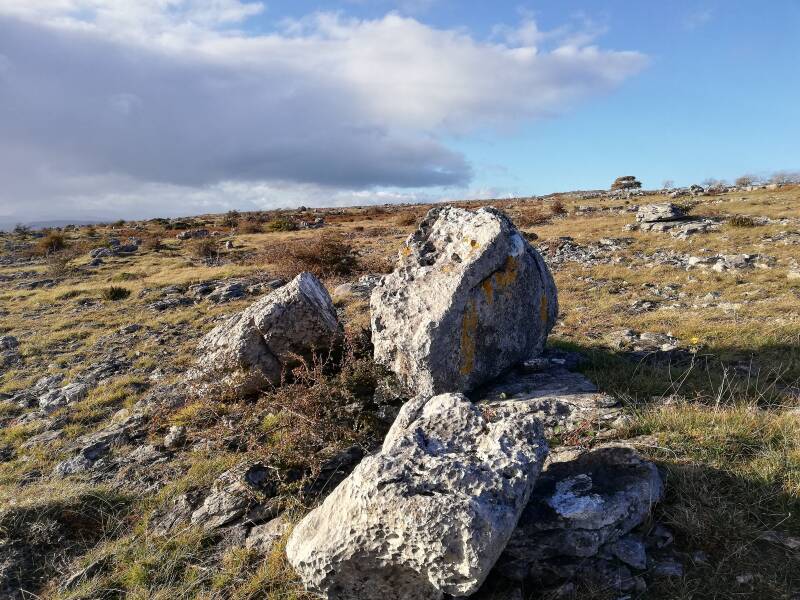
Photo below: another possible dolmen-like structure. This example in the photo below does not seem to have been a single erratic.
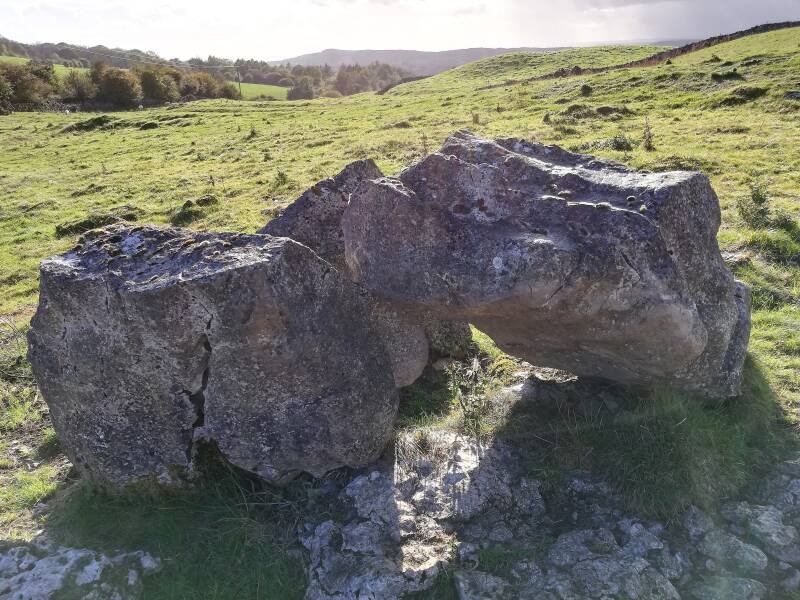
Some of these structures on Farleton Fell, similar to some of those elsewhere in Cumbria such as many of those nearer to Beetham I have seen before, seem to be formed from single rocks, sometimes, although this is not always so, and other examples are clearly made from multiple individual megaliths. The origin of these structures is mysterious and unknown, and they do bare a similarity to other structures in other parts of Europe and beyond. Structures like this are sometimes associated with ancient witch and divine feminine traditions.
I have discussed many other archaeological sites and potential archaeological sites in this region before. There are a few others I noticed over the Christmas period over a month ago, which I would also like to describe here. I noticed one other possible stone enclosure, in the shape of a passage tomb, athough probably not a passage tomb, when walking near the Dog Hole Cave near Beetham over Christmas. I have discussed many other sites around there elsewhere, but I noticed this new possible stone structure, consisting of several large stones forming a sort of enclosure, in a forested area where trees were recently cut down, at approximately the GPS coordinates of: 54°12'46.8"N 2°47'54.1"W . This site is very close to the stone steps (not the nearby Fairy Steps but another group of old-looking stone steps not so far from the two sets of Fairy Steps). The ground in this area had been badly damaged by forestry work.
Also over the Christmas period when walking around Leighton Moss near Silverdale (not to be confused with Haweswater/Hawswatter nearby) - around Leighton Moss, I noticed what looked like a couple of possible standing stones close to the wetland area. In addition, far above the hall, is what is known as the Summerhouse Stone Circle and cairn. The cairn is ancient, the stone circle is perhaps more akin to a group of widely spaced large megaliths surrounding the cairn on three angles, at a distance from it. There is no accepted consensus on whether or not these stones were placed there naturally or not. Not far from here, on the path towards Leighton Hall, is what appears to be a stone row, among other large megaliths. The stone row near the path on the open field is not so ancient looking, but a path also goes from here, through the woods towards Warton, and this stone row in the wood does I think look convincing as a stone row.
I hope that this article was an interesting read. God bless all.
Add comment
Comments