Written and published by Linden Alexander Pentecost. The photos were also taken by Linden Alexander Pentecost. This article or blog post was published early on the 11th of February 2026, and is the third blog post I have published on this site already this morning. I will probably publish no more blog posts today, I am not sure though. Like my other publications this article was published in the UK and is unrelated to my other publications, and no AI was used. This article contains 3 photos, which, along with the photo descriptions in Italics, are also important alongside the much longer main text. This article or blog post contains a total of 1086 words.
Northern Norway contains a wide number of prehistoric sites, and like other parts of Norway, standing stones are found - although those in the north of Norway are commonly rather tall and narrow. This form of menhir or standing stone is in many senses akin to some of those I have seen in western Scotland, in certain localised areas. Unlike in Scotland though, most of these menhirs and groups of standing stones in Norway tend to be dated to the Iron Age, although certainly the use of these menhirs and standing stones of this type likely connects to earlier megalithic traditions too.
Many of the standing stones in Northern Norway are distinctive in their tall shape, and often, like for example the Priapus Stone at Great Urswick and the Gettlinge Gravfält stone ship bow stone, discussed in another blog post also published today, have features that make the stones appear shaped a little like human figures. I am not referring to all standing stones here, but specific groups of them with this same look, others are found in the mainly western Outer Hebrides and Kintyre for example, although these are dated to older periods and I do not know their relationship to those in Scandinavia, but I think the possible relationship would certainly be pre-Norse and probably pre-date the Iron Age by a long time. I believe that the Viking period in Western Scotland was in a sense a continuation of these earlier connections.
Some beautiful and impressive examples of these forms of standing stones can be found at Vågøynes, close to the city of Bodø in Northern Norway. I have discussed the language and history around here elsewhere, for local to this area the distinctive Salten dialect of Norwegian is spoken, whilst in Bodø itself a more Urban form of this area's general dialect is spoken.
There are many other such sites in Northern Norway, but Vågøynes does have three of these distinctive standing stones in one place, each upon a burial mound upon which the three stones stand. The tallest of these stones is four and a half metres tall, the others are around three and a half and two metres tall respectively. The tallest of these stones is not as tall as the Baldersteinen near Husabø in Western Norway, which stands at around 7.8 metres tall, and is truly enormous, but those at Vågøynes are indeed tall and impressive. Note that the Baldersteinen is not to be confused with "The Bowderstone" or in Cumbrian dialect T' Bowderstian in Borrowdale in Cumbria. Although the name "Bowderstone" may have an underlying earlier root word which I have discussed elsewhere, it is also possible that the Bowderstone did become associated with, or was originally associated with Balder, just as the Baldersteinen in Norway is.
The general formation of the Vågøynes standing stones reminds me a little of the formation of the three Björketorp standing stones located in the Blekinge region of Southern Sweden. The tallest of the Björketorp standing stones has upon it the Björketorp Proto-Norse runic inscription, which I have discussed in a different publication with a photo and translation and other details and topics. This standing stone is around 4.2 metres in height, making just a little smaller than the tallest of the Vågøynes standing stones. The general shape of the tallest of the Björketorp standing stones also has a humanoid shape, albeit more angular and less thin and tall than many of the examples in Western Norway.
Photo below: the tallest of the Vågøynes standing stones, looking off across the valley, the angular but tall humanoid shape clearly visible. This photo was taken on a cold April day back in 2018. Note how the stone seems to bulge slightly but not at the top, this remind me a bit of a skirt or cloak perhaps, whilst the top of the stone resembles to me the hooded head of an ancient priest or guardian, and I do believe that these stones are the physical forms and connections to our world of these guardians, but this is my belief and not something I can say for sure.

Photo below: another of the standing stones at Vågøynes, this one is smaller, note the snow in the background, in April it is still pretty cold in Bodø and becomes very cold as one moves away from the sea or towards more sheltered areas.
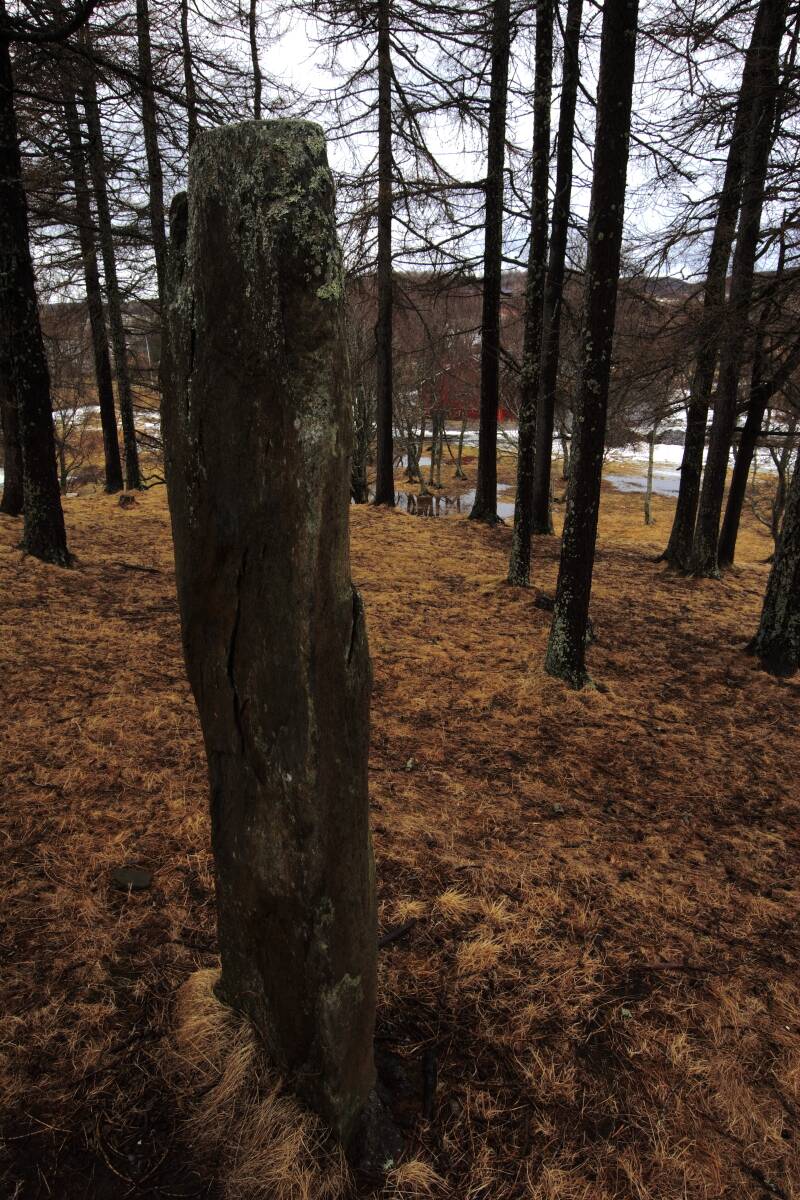
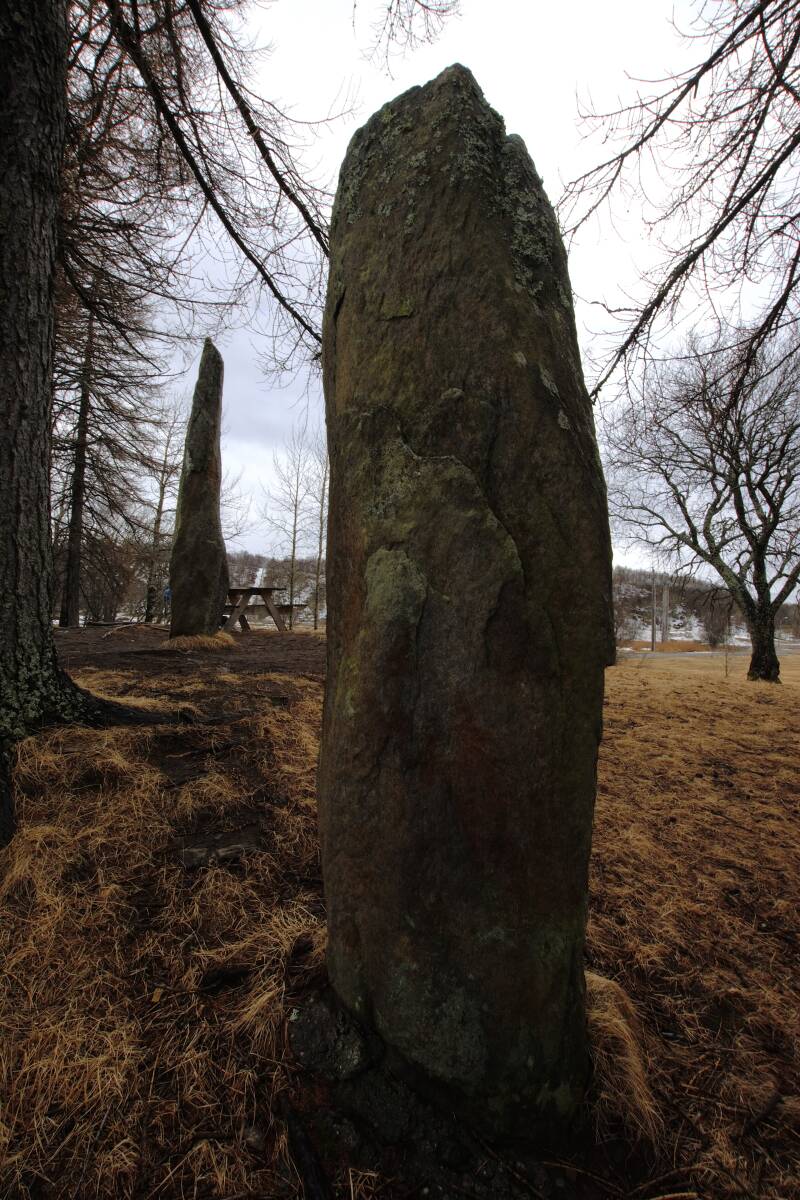
Photo below: another of the standing stones at Vågøynes, with the largest standing stone of the thee visible behind. The shape of the mound is also somewhat visible in the photo below.
When I visited the Vågøynes standing stones it was cold, I headed up a track towards the mountains briefly, but the snow was thick. I remember sitting in very warm clothes and reading a bit of a book, whilst sat beneath a tree next to a path going through the fir forest, with snow in deep drifts and all over the walkways. When I got to a less snowy area of the path, I drank a little whisky, and sat and down and read again for a bit, before heading towards the standing stones. There are also other standing stones and different ancient sites around and not far from Bodø, and standing stones are found up the coast of Nordland towards the Ofotfjorden, and are also found in the Lofoten Island and Vesterålen, and north of there. I hope to visit more in the future.
I hope that this article was an interesting read. Thank you for reading. This article is dedicated to my family, to angels, and to the guardians of these standing stones, to who I am very grateful and in awe of.
Add comment
Comments