This article/blog post was written and published by Linden Alexander Pentecost, and was published on the 11th of February 2026, after having already published three other unrelated blog posts on this website earlier today. Like all my other publications, this blog post was published in the UK, and only on this UK website www.languages-of-linnunrata.co.uk (which is not the only website I own and use, I have several others). I the author am also from the UK and live in the UK. No AI was used in this publication nor in any of my written works. This blog post/article is unrelated to any and all of my other publications. The three photos showing different parts of Báddosdievvá included in this article were also taken by the author, and are important, as are the photo descriptions above each photo, which contain information not in the main text. This article or blog post contains a total of 2199 words. The photos have also not been published before. Note that in other publications including on this website I have discussed other aspects to this area, including on the Meänkieli and Lannankieli languages, Lannankieli as well as Northern Sámi was historically spoken around Lake Torneträsk, although I do not know how the Lantalaiset may have viewed or named Báddosdievvá, they nevertheless also likely viewed it as a sacred place. The mention of the whirlwind in this blog post could perhaps be connected to the Sámi god Bieggolmai, I have discussed the Inari Sámi name and Finnish names for this god elsewhere, including on this website in other blog posts.
I do not know for sure how the Sámis understood the spiritual importance of this site, but when I went there, it was quite profound, and also quite scary. I will go on to explain why. The sacred site of Báddosdievvá is located in Sápmi, in Northern Scandinavia. Such sacred sites of unusual stones, megaliths and rock formations are often referred to in Northern Sámi as a sieidi, of which I have also seen and visited other examples and discussed some others elsewhere, and will discuss more in the future.
I visited the Báddosdievvá in September 2018. The previous day I had gone for a small hike, but the snow started coming down in a blizzard. It was not that cold, the temperature near the ground was maybe two degrees celcius, but this made the snow even more dangerous in a sense, because as it landed in big flakes upon me, it melted, making my clothing wet. It was difficult, it did not start out as a blizzard, but as I hiked, it became one, and even though I was following the path, and the trees either side helped to give me my bearings, it was still hard to see with the snow flying into my face, and everywhere around. It was by this period that I also noticed I was getting wet, and so, at just about 500 metres from the train station I set off from, I made the decision to turn back, and rightly so. Thankfully the large toilet (for one person and with a lockable door) in the station had a radiator at the time, and I went in, locked the door, and used it to dry my clothes as I spent an extended period in there, and also I was able to warm up. I could have been dangerously close to getting hypothermia, that's for sure.
When I had dried, changed some clothing and dried some of my other clothing, I got the train back to where I was staying. My closeness to the danger of the mountains that day had been scary, and I felt mentally quite overwhelmed, and so went to sleep at the place I was staying in Abisko. During the night, I had only what I can describe as a night of nightmarish dreams, in which I saw my room, in a strange colour, with a dark shadow in the corner that seemed to be eminating from it a lot of fear and misunderstanding towards me. I don't think it was evil, but it was something that clearly didn't understand me and which felt threatening. I didn't sleep too well, to say the least, and woke up in the middle of the night, and went to the shop to buy some sugary stuff - because, stuff like this, from my experience, numbs the nerves and senses a little, after things that are somewhat traumatic - even in reality I'm not sure if this is a good thing. Sugary things in a healthy amount do help to provide energy and to warm the body of course when needed. I slept again, and the next day I felt strange, mentally tired, in part from the nightmares, but I felt that I had the energy to go for a hike again. In reality I am not sure, looking back, if this was the sensible thing to do, because on retrospect my energy levels were not back to normal, and although the weather was better, I really probably shouldn't have gone that day, and don't recommend anyone to do similar when feeling low on energy like this, especially after being cold the previous day.
I hiked towards the famous and imposing mountains that form Lapporten, or in Northern Sámi, Čuonjávággi, "Goose Valley", a site of sacred importance, although as with Báddosdievvá, I also do not know the history around why these sites are sacred exactly. The walk was strange and peculiar as I headed towards Báddosdievvá. I was not in the high mountains, but in the lower areas of mountain, rocky crags, marshy areas, birch forest, for miles and miles. I followed the path but it felt so strange. The atmosphere was so incredibly silent. There was a fair amount of snow on the ground in places, especially so in some places, and I went past streams and marshes, past more crags, until the trees started to thin out slightly, and I saw in the distance the promenant rock formation known as Báddosdievvá. The entire walk up to this point had been so silent and eerie, there was virtually no wind. The sky did not look like it was going to snow, but it was dull, grey. I had not met a single soul on my walk. I had let people know where I was and the route I was taking though, in case they learned from the forecast that it was going to snow and needed to help me.
The land slowly became steeper as I walked towards Báddosdievvá, and the land here was more bare, although I came across patches of greater numbers of birches. I walked across a more gently sloping area. About 30 metres away from me, some elk were grazing, their antlers dark and standing tall against the high grey cloud in the sky. I soon reached the central, uppermost area of Báddosdievvá, which was in a sense quite level, but which also contained many unusual rock formations. The atmosphere was powerful and charged. The cloud on the mountains around Čuonjávággi came down. Luckily, from where I was, I could easily see the path back down towards the lake, where there was no cloud, and where I could easily get to Abisko Östra station. I was ready to leave, but the cloud stayed put, and it did not appear to be snowing on the mountains at this point, although it was hard to tell of course.
I stayed for only a few minutes before heading down, in which time I became keenly aware how I felt utterly out of my element at this place, not in a sense of being physically afraid as such, rather in a sense of feeling with great intensity the spiritual power of this place. It was so quiet there, the power seemed to hang in the air and in everything around me, and I was at the centre of it. The feeling I got was that it was something big, something intense. For a few more minutes I let myself listen to it, simultaneously keenly aware that I was about to leave. I was feeling the place's power, like a slowly surging electric current, slowly rising in pitch and in intensity. I thought about the things I had experienced over the past year, some of its sadness, and with a particular thing pertaining to my family, I asked for help, from the ancestors of that place and of those surrounding mountains.
Almost immediately after I made this wish, a fierce wind swept from the mountains, not at this moment so loud, but sudden, intense, intentful. The wind continued to blow, this time getting a little louder. It was time to leave. I headed away from the central, slightly wooded area of the site, and down towards a more open area, then easily onto the path down, generally speaking, towards Abisko Östra station.
As I reached the open tundra-like landscape, with fewer birch trees, heading down hill, the wind intensified and howled behind me, whooshing down towards Lake Torneträsk. I descended the mountainside, the lake getting closer. The wind continued to blow and whoosh behind me, but after getting a significant distance lower down, it lessened, and I followed a series of sometimes vague paths back towards a path in the forest, which still had many autumn colours, and then I reached Abisko Östra station.
The wish was granted, the help came in my life. I am thankful to that place and to the gods and to the Great Spirit. As for the place itself, being there at that moment felt like being on the edge of an enormous portal connected perhaps to the U-shaped valley of Čuonjávággi, a very thin place, a potentially dangerous place when not respected. And the way in which that wind had suddenly appeared, felt like it came from there. This place is indeed highly mysterious, and should be respected including for its potential dangerousness, as the Sámi revere and respect this and other sieidi sites in Sápmi. It is also noteworthy that winds like that I have just described are skin to whirlwinds, in the spiritual sense whirlwinds are often associated with an interaction with supernatural powers and deities, and even with the Great Spirit - but they can of course be dangerous.
Below are some photos with photo descriptions above each of them, after the third photo is another short paragraph.
Photo below: a gap in the unusual rock formations at Báddosdievvá, the phantom wind or whirlwind came from roughly but not quite the direction in which this photo is showing. Note the unusual rock formations with the appearance of having "bands" across them and the formation on the right shows a rock formation with an appearance a little like a wall made of parallel pieces of slate. Of course it is not slate. Clearly in some way though the geology of the Báddosdievvá crag is different in some way.
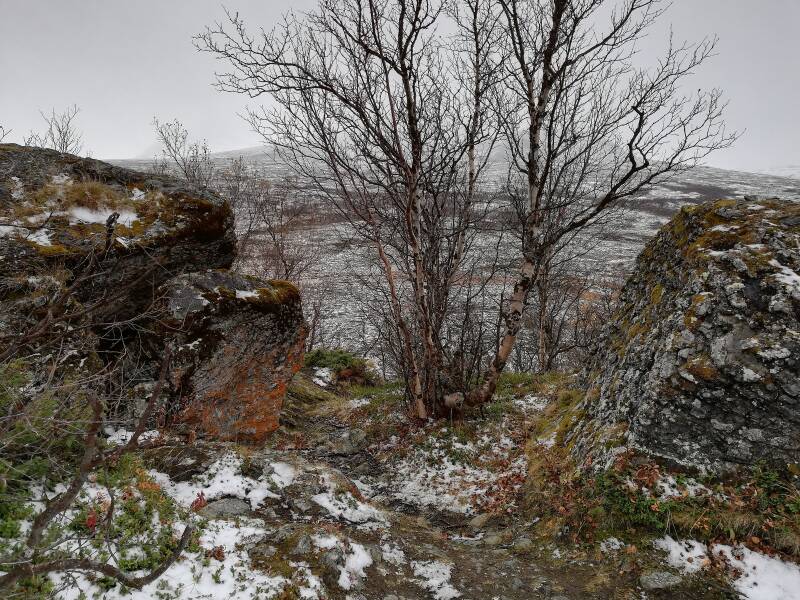
The photo below shows another angle of the site, this time a close up of some of the other rock formations, showing the geological formations in more localised deail. In some ways the surface of this rock resembles something akin to the surface of a slug, although of stone of course. The orange bands in the rock are also interesting.

Photo below: another view from Báddosdievvá, looking down towards where Lake Torneträsk is, to the left. Note the other rock formation in the photo below, which is a part of the same geological formation as those bits of geology visible elsewhere on the site in the previous two photos.

I hope that this article/blog post was an interesting read. A note I would like to end this publication with is that the mountains of Northern Scandinavia are very dangerous, and it's easy to get caught out by the weather, so may this article be a warning about those dangers as well as describing the sacred sites in question. A second note is that Sámi sacred sites, with those connected to rock formations often being called a sieidi, are places of power and awe, and they deserve our respect, and also it should be noted that these sites are very often "thin places" where one can interact with the other realms in a more profound way, which can sometimes be quite scary - which is another reason why they deserve our respect and why we should in a sense also fear the power of these places, not because this power is in any sense bad, but because these powers, like the powers of nature, cannot be controlled and are much more powerful than we humans are. This is perhaps especially true for Báddosdievvá and with its proximity to the U-shaped portal, both a physical portal to the mountains and perhaps a physical portal to the Otherworld, known as Čuonjávággi.
I hope that this blog post was interesting, it is written in honour of the Sámi and of their ancestors and gods. Giitu - thankyou.
Add comment
Comments