Written and published by Linden Alexander Pentecost, photo also taken by Linden Alexander Pentecost published on the 18th of February 2026. This blog post or article is an overview with some new information regarding topics I have discussed in much more specific details elsewhere, nevertheless this publication contains unique information not found elsewhere. Published in the UK, and I the author am from the UK and live in the UK. No AI is used in any of my writings including in this. The photo in this article has also not been published before. This article or blog post contains a total of 1920 words. The main article begins beneath the photo description and following photo below, the photo was also taken by myself the author back in 2008 and has not been published in a written work before. The photo description also contains information not in the main text. Note added on the 19th of February 2026: later this day I will also be publishing another article, which will be my first publication on a different new website, which will be about Northern Sámi language, and a new introduction to this language, the new website is titled: https://www.kielimatka-2-11.co.uk/ . The website you are currently on is: www.languages-of-linnunrata.co.uk . The new article on the new website will be unrelated to any previous publications concerning Northern Sámi. The aforementioned new publication will be unrelated to the first article every published on this website, www.languages-of-linnunrata.co.uk , although the first article on this website you are currently on also relates to different aspects of language in Northern Scandinavia and to Narvik, which is also mentioned in the article being published later today. Note that this website you are currently on is also not that old.
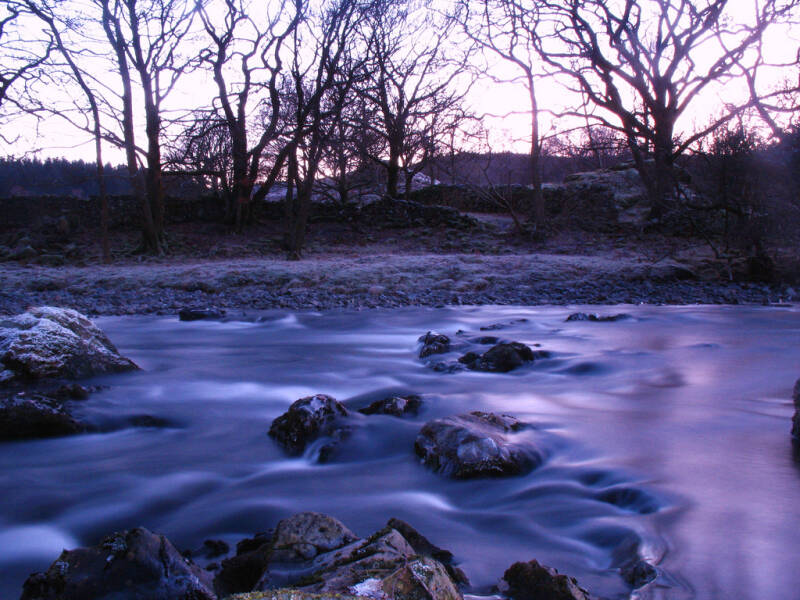
Photo below: the River Duddon, taken in late autumn on a long exposure. This photo is unrelated to a long exposure I took of a different part of this river in 2011 in summertime and which I published on a different blog post on this website. The photo below for me captures something of Cumbria's deep ancient essence, when I first took this photo, I gave it the title of Aḃan Dwddon, which was a reconstructed Cumbric rendering of "River Duddon". Duddon I think could be connected to the English word dod- and to various non-Indo-European roots, which I discussed recently in a different article and elsewhere, Dwddon being a Revived Cumbric spelling of this river name, with Aḃan being a spelling for the Cumbric version of Welsh afon - "river", and Gaelic abhainn - "river", the character ḃ I used because the sound could have been closer to a B. Of course since this time, my views on Cumbric have greatly changed, as I will explain more in this article.
How we view the history of Welsh ultimately depends on how we perceive and analyse, and connect its root words to other languages. The commonly held assumption is that a Proto-Indo-European language, in the Bronze Age, came from the east, and evolved into a Proto-Celtic language, which by the Iron Age had reached Britain, before evolving into the Welsh, Cornish and Breton languages - whilst another branch of ancient Celtic in Ireland evolved into the Goidelic Celtic languages: Irish, Manx and Scottish Gaelic.
I have felt for a long time however that the evolution of Celtic languages, from their almost Latin-like Iron Age ancestors, to the modern languages, using entirely different grammatical and phonetic systems, and often having different words - is not a process that could have happened within just a couple of thousand years. Personally, I think that Welsh, and the modern Celtic languages in general, are not entirely linear in their origins, but rather can be shown to possess multiple aspects within them that correspond in some way to different language families. For example, one can observe Indo-European aspects to Welsh quite clearly, but, this alone does not to me prove a direct linear transition from Proto-Indo-European to Welsh, because many, including myself, have also commented on how Welsh can share similarities to Afro-Asiatic languages, languages in the Caucasus Mountains, and even languages far beyond there.
What I believe personally is that Welsh is not just a Celtic language and cannot really me entirely encompassed as "Celtic" culturally either, because the classical Celts and their languages, were not alike Welsh culture and language in a lot of important ways. I think it more likely that several threads of linguistic influence within Welsh, actually have less to do with the Classical Celts, and have far more to do with the indigenous languages spoken in Britain thousands of years earlier, although I believe that the "Indo-European" system probably became at least more prominent during the Neolithic, because this was the time that would have required for example, common numerical systems for counting and measurement. Although again, the actual wider expansion of these linguistic systems and language, and their incorporation into Indigenous languages may have been a slow process, and it is only really during the Bronze Age that agriculture really expands.
I personally believe that the language we identify as "Cumbric" possibly a pre-Celtic language rather than a Celtic language per-se, may have expanded widely in southern Scotland during the Bronze Age. One of the most substantial areas of evidence for this language comes in the form of numerical systems, known as "Cumbric sheep counting rhymes", which are generally thought to be medieval in origin, but which I think could be Bronze Age or Neolithic in origin. Further implication that these Celtic-like influences in Cumbria were more ancient, can be seen in how Cumbria seems to share a lot in common with Ireland, Scotland and Wales, during the Mesolithic, Neolithic and Bronze Ages - but not in the Iron Age to nearly the same degree.
Our "linear" understanding of Welsh language history is also interpreted from the way in which written Celtic languages appear to change over time, for example, there is Gaulish, and some examples of Gaulish-like language names and an inscription in England. Then we have examples of Old Welsh, then Middle Welsh, then modern Welsh. From a linear understanding, this appears like rapid progression and change from one form of language to another. But there is another possibility that is rarely considered: that written language varies in terms of what is considered "the language for writing" at that particular time, which does not necessarily represent how people speak and what languages are spoken at that particular time. In this vein, both Middle Welsh and Modern Welsh could theoretically be far, far older than assumed, with the attestation of each being dependant on what was the dominant culture of transmission and writing at that particular time. This potentially creates an entire reversal of the specific linear view of Indo-European languages - which is obviously problematic, and I wish I had a simple solution. But when we're speaking in terms of thousands of years of history, most of which we know little to nothing about - the linear explanation, which makes sense in our modern mindset, might not actually represent the truth. Take for example the way in which England and France have shared a relationship for a long time, with the Gauls, using Gaulish as their written language, then the Romans, using Latin, then the Danes, using a form of Old Danish, then using Norman French.
What happened to these other, "less-Celtic" cultures, where did they go, and what ultimately happened to their languages?
I am inclined to think that modern Celtic languages, especially on localised, dialectal levels, actually contain within them large portions of other languages, or connections to other pre-Indo-European languages. The languages themselves can be shown to have existed where for example extra-Goidelic, extra-Brittonic and pre-Celtic numerical systems occur, and I think in areas with high localised dialectal differences, high numbers of certain place-name elements, and many other things.
I am also of the belief that these other cultures became classed as travellers, or even sadly as bandits and pirates in more recent history. Still "other" cultures come to us through mythology, and the legends, places and even language and music, associated with those ancestral figures that take the roles of divine ancestors within our mythology, although a certain number of these are no-doubt also connected more closely to what we call "Indo-European".
As this blog and many of my other publications attest to, Cumbria and the "Cumbric" area in general contains a lot of potential archaeological sites, which in my opinion have not been properly identified in the mainstream yet, because the precise nature and structure of many of these archaeological sites I have looked at (not including the already-recognised ones) are not easily comparable to the exact designs of passage tombs, long barrows etc visible in other parts of Britain, Ireland and elsewhere, subsequently most archaeologists would have have no reference point for recognising many of these sites in Cumbria as being ancient. I have written extensively about all these subjects before and have published a LOT on these subjects with lots of different types of evidence.
On a different note, I am reading a fictional book at the moment, titled: A Study in Drowning by Ava Reid. I like this book, I bought it from Fred's Bookshop in Ambleside. This is a good bookshop. I did buy two other fictional books from there when I visited a few weeks ago, but this one, A Study in Drowning, I like the most. Although I have not got to the end of this book yet, I will say that it seems to be set in a fictional world which is rather directly connected to certain realms, concepts and themes present in Brythonic mythology, with certainly a part of this world speaking a language very close to, or largely identical with Welsh, with some of the other words appearing like English, others like Breton. From what I've read so far, I don't really agree with how selkies are discussed in this book though, I think maybe the author did not acknowledge the Finnmen, Finfolk, Gandfinner, Drauger and many other selkie-like ancestors who were just as often male rather than female, although they could have maybe known about these things and simply did not choose to represent them in the story.
The aforementioned book is also another example of the way in which Brythonic history and language seems to endlessly inspire works of fantasy, and simultaneously to relate to many of their most ancient roots, another, less direct example being the way in which J.R.R. Tolkien based one of his Elvish languages partially upon Welsh - although, I personally think that in a sense he was trying to recreate and reconstruct an actual divine language or group of languages which were then presented as fictional, and which were not entirely made up. But that is my opinion, and I have elaborated on it further elsewhere.
I hope that this article was an interesting read. It is dedicated to the ancestors of Wales and Cumbria, to my family, and to all writers to aim to inspire hope and love. I will discuss more on these topics in the near future, and wish especially to discuss the topic of whether or not there could have been a specific extra-Goidelic influence around Ullswater. Many thanks.
Add comment
Comments