Written and published by Linden Alexander Pentecost and published on the 20th of February 2026. This article/blog post is not the same as, and contains different written content and photos from that which I have discussed in any other publication, including others which discuss other aspects to the Pike O' Stickle and its "axe factory". This article was published only on this UK website, this article/blog post was published in the UK, and I the author am from the UK and live in the UK. The six photos in this article were also taken by myself the author, two of them show different parts of the rockface with the possible carvings, the other four photos show other parts of this site and of its general area, which, like the content of this article, containing lots of very new information, have not been published before. Note that I have been publishing a lot lately, including on this website, other websites and some PDF books, and that yesterday I also published my first article on a brand new website (not the website you are currently on nor any of my other websites, all of which have different content to each other). I may also publish other, unrelated blog posts on this day (the 20th of February 2026) on this website and may also publish something else on this date on a different website too, all these publications being unrelated to each other. This article/blog post on this page in front of you contains a total of 3158 words (making it quite long, but not nearly as long as the article I published yesterday for instance) and 6 photos, the photo descriptions in Italics also contain important information not in the main text, and the photos themselves are also important in addition to their associated Italic texts and to the main parts of the text. Many topics are covered in this blog post which connect to the Cave on Pike O' Stickle, to its mythology, to etymologies, to wider mythology, thunderstones, thundergods, and things also related to the possible carvings at this site and to other carvings, and to many other topics. Note that this publication on this page is also unrelated to for example another recent article on another website about Grimes Graves Flint Mine in Yorkshire, where I discuss some topics that link in with, but are separate and different from, those of the article in front of you. Note that in my article published yesterday on the brand new website I also talk about symbolic written language symbols but in an entirely different context and with other information.
One rather unique place in Cumbria is the so-called "Axe Factory" on Pike O' Stickle, above Great Langdale. I have discussed this site several times elsewhere, as there is a lot to it, and I have included other photos elsewhere too (in other publications, including mentioning the site and discussing it a little in other blog posts on this website). The main feature of the site which sets it apart from other prehistoric hornstone quarries around Langdale, is the presence of a small "cave", in fact an ancient mine, although I do also wonder if this cave had a spiritual purpose. The stone mined here, was so in my opinion, due to this location being sacred, and perhaps even due to the acoustic qualities of the rock itself, something which can be demonstrated by gently tapping two pieces of the hornstone from this area together, which produces a kind of ringing sound. The mountain itself is also "bell-shaped" and I have wondered before whether or not this symbolism, and the "sound" produced by and connected to the rock here, could be representative in some way of the Arthurian legend in which a man goes into a sacred mountain cave, to find Arthur and his Knights sleeping. Often in these stories, which I have discussed in detail elsewhere, the man upon exiting the cavern has to climb beneath a large bell, knocking this bell and thus ringing it wakes Arthur and the Knights.
The "cave" at the "Axe Factory" on Stickle Pike, which is better described as a prehistoric mine and sacred site, is not a very deep cave. The cave has a door-sized entrance, leading into a small chamber, which extends some way particularly to the left, where it extends into a further narrower passage and into another small chamber. There is also another start of a passage from the first chamber, and in one place the daylight almost breaks through to the chamber at another point.
Of course it is entirely possible that there could be, or could have been, more working areas, possibly even another small "cave". For instance, other working areas could theoretically be buried beneath the scree-slope which runs downwards outside of the cave entrance. Furthermore, what might have been earlier evidence of quarrying or mining could have been destroyed by later mining, all of this is uncertain though. What is certain is that there is probably a fair bit more scree overrunning the site than there would have been during the Neolithic.
Another aspect to this site I have discussed before is its possible connection to sky or thunder deities, there is good reason for me believing this - I think, as I have discussed elsewhere, and it has to do with the legends surrounding the axe heads, the material it is made from, similar materials, and the folklore which surrounds them. There is another prehistoric "Axe Factory" near to this one on Thunacar Knott, and as I have commented elsewhere, this may be an Anglo-Norse personal name that might mean "thin curl", as in, hair, or even "thin copse wood", although Icelandic kárr is also related to the name of the Valkyrie Kára and here "curly" means something more like "wild". So the place-name could mean "Thin-wild one's Hill".
It is entirely possible that Thunacar Knott as a name does result at least in part from a later Anglo-Norse interpretation as meaning something like "Thin Curly One's Hill/Thin Wild One's Hill", although, as I have commented elsewhere, I also think it possible that a deity name could originally underlie this place-name element, especially the Thun- part. I am doubtful, for one, that "thun" is equivalent to how the word for "thin" sounded in Anglo-Norse. I also think it possible that the first element could instead be related to "thunder", compare for example Icelandic: þruma - "thunder", that is arguably similar to "Thuna" in "Thunacar Knott". The place-name "Thrumster" in Caithness may carry a related etymological meaning to one or more of these root words. The second element in "Thunacar" could be related to Icelandic kárr meaning "curly" or by extension, "wild" in the context of the Valkyrie Kára, which could also in a sense imply a kind of deity, or, the second element in the name could instead refer to a marsh or even to something akin to Welsh caer or some other element.
Whilst I am still unsure if the name Thunacar is perhaps to a "thunder god", the name itself, if Anglo-Norse, may imply a deity, or may to some extent have very ancient origins, especially given the presence of the other "axe factory" there. And I also have an even better suggestion, that the "Thuna-" element in the name may also correspond to the older English name Thunar, which referred to a god or deity, identical with or sometimes connected in some way with the Norse idea of "Thor", whilst the second element "car" could also be related to Northumbrian "carr" meaning a rock rather than a marsh. If the two most aforementioned etymological suggestions hold weight, then Thunacar Knott could have originally been something like "Thunor Carr Knott" meaning "Thor Rock Hill". I would be interested to know what others think.
The subject of the "thunderstones" towards more eastern parts of Cumbria are also fascinating in and of themselves, and I have discussed many aspects of them elsewhere, but will describe them with new information here. "Thunderstones" in the Cumbrian sense of the term are large megaliths, thought generally to be erratics, the shapes of which often resemble giant bird heads or elongated human heads with fish-like features. Unusual, right? Well, not really, I have also discussed other examples of similarly shaped stones and other stones shaped in different ways in Cumbria and elsewhere, including in other blog posts on this website recently, and other publications elsewhere. I for example discussed the giant elongated-head shaped megaliths at Dovedale Prehistoric Enclosure in another blog post on this website. I have also discussed in detail for example several times and published in different places a "thunderbird-like" stone carving found at St Patrick's church at Heysham in Lancashire, and how this pertains to the Native American beliefs around thunderbirds, sky deities. I have also discussed much with regard to elongated headed peoples generally in many other publications.
So what is with these elongated-head-shaped and bird-head-shaped megaliths in Cumbria? Due to that many of them are referred to as "thunderstones" in a certain context, I suspect that this is the survival of a belief regarding these stones, and other ancient sites, as having been connected to groups of deities that were thought to appear in this way, i.e. which were thought of as looking like humans with long, tall heads, and with aquatic, fish-like attributes, or which appeared as giant bird-type entities, like the thunderbirds known to the Sioux for example. We can see similarities here also to for example the sacred clowns, and a connection with "giants", and in terms of other aspects, we can see connections with the Apkallu known to the Sumerians, to the Mythological Finns, and to many other ancient cultures. These connections are not always direct or so specific, but sometimes they can be, and I suspect that the ultimate implication is that - a long time ago, these ancestor beings were known in Cumbria, they may have in some way be connected to the "giants" too, if not directly, and may have helped or organise and to create ancient sites, according to ancient beliefs, hence why giant effigies of their heads may be found for example at Dovedale Prehistoric Enclosure and at many other sites. There is also the aspect of how, according to many indigenous beliefs, including those in Britain sometimes, these ancestral beings were actually turned to stone, which is why, one could also suggest in some animistic way, that these "thunderstones" in Cumbria and other similar-shaped stones might be the fossilised forms of these ancient beings. I will also say that once one looks at the shapes of these thunderstones to the east, and see their human faces, long heads, bird and fish-like features, depending on the individual site, one cannot unsee what they are representing, in my opinion.
I have also discussed elsewhere with regard to Pike O' Stickle the way in which some think of rock formations, and for example, of quartz, as being the "veins" and "nervous systems" of ancient fossilised beings. I have discussed other aspects of this elsewhere. It is also interesting for instance how Stickle Pike, a different but similarly named mountain near the Duddon Valley, also has prehistoric sites around it, and it the rock at this site, albeit to a lesser extent, makes a rining or chyming sound, just as it does at Pike O' Stickle. I have also discussed the etymology of "Stickle" elsewhere and how it may be compared to the word "icicle" in English, with a suffix implying something solid, and with the stick- prefix implying something that stands, adheres or which sticks. I have discussed different aspects to this elsewhere.
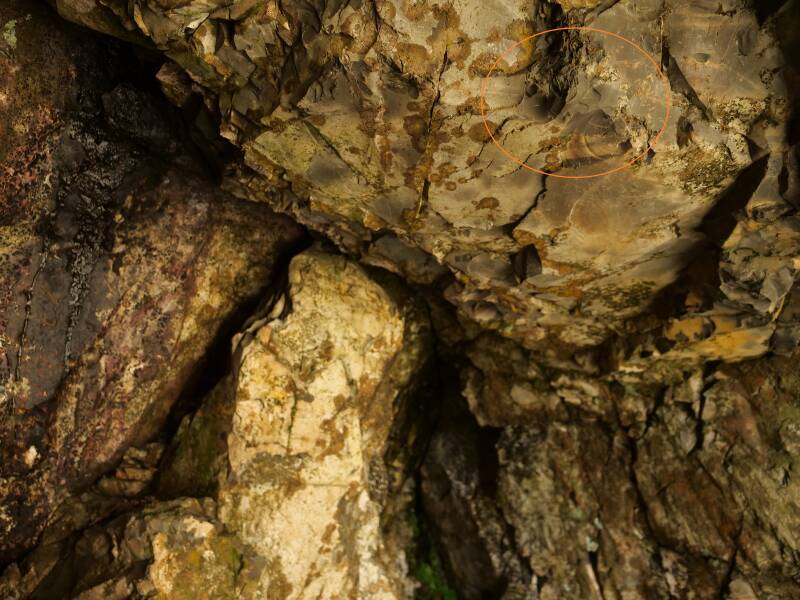
When I was at the "cave" on the Pike O' Stickle in spring 2021, I also noticed on the rockface to the right of the cave entrance and slightly upwards, the presence of several possible markings, which are detailed in the photo descriptions concerning the two photos showing these markings. I also noticed that on the Modern Antiquarian webpage for the "Langdale Axe Factory", someone has also included a photo of what they believe, from what I understand, could be markings in the same area as where the ones I discuss in this article are located, although the ones shown in the photo on The Modern Antiquarian are not those which I noticed, and are more generally linear than the ones I show in the photos on this article.
I would also like to comment on another recent blog post on this site regarding possible carvings or markings at Victoria Cave in Yorkshire, and I have written and published about others elsewhere, including other Neolithic examples - although a few of those I include in the blog post about Victoria Cave (not the first publication either on markings at that site), may in some cases just be natural scratches in the limestone, although I am inclined to think that many of these natural cracks may have been expanded or altered by human hands, and I am certain that some of the examples I discuss in that article and which are in the photos, are indeed ancient spiritual marks and symbolic language.
The photos below and the photo descriptions above them provide further information and context about and to the "Langdale Axe Factory" and the markings at the "Langdale Axe Factory" in question.
Photo below: the main area of the Pike O' Stickle "Axe Factory", with the cave entrance visible centre left of the image. Note how the area in the foreground, which constitutes a kind of "gollick" (a Cumbrian word for a "ravine"), is very overrun with scree, including with some large boulders. This is one reason why climbing up or down the scree slope to visit this site is not safe, as it is very steep and these large rocks can dislodge themselves, especially if the scree is disturbed, e.g. by walking up or down it.

Photo below: a view from the scree slope below the "Pike O' Stickle Axe Factory", the photo I think well demonstrates how steep and how, quite frankly, frightening it is to walk up here, I do not recommend it, it's quite frankly very dangerous. The photo below also though helps to give some perspective on how impressive the view is, and how dramatic the nature is, and the photo below was not even taken from the top.
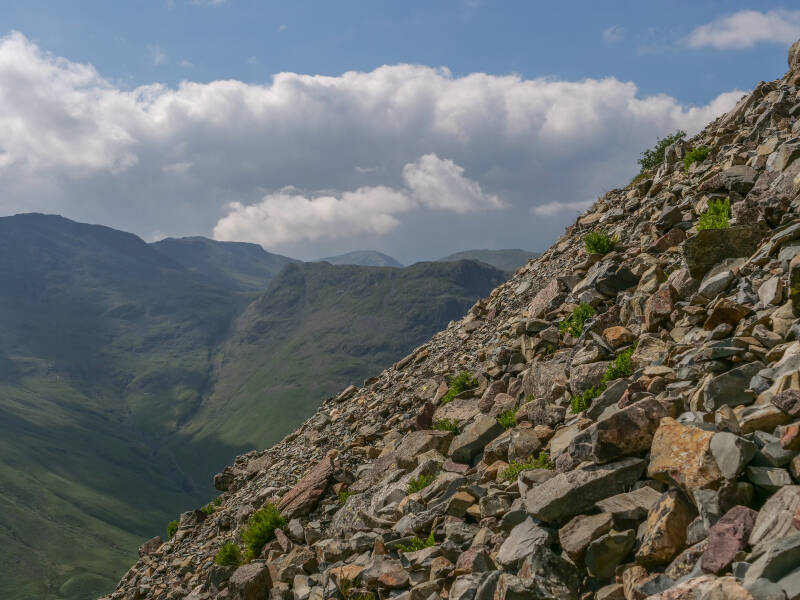
Photo below: a view looking down the gully or "gollick" from below the Pike O' Stickle Axe Factory, the photo below also like the other photos, helps to demonstrate how steep this gollick is, and the view which it commands over the nearby mountains and dales. There must, presumably, have been specific pathways that the Neolithic miners (or rather miners & spiritual folk) must have took to reach this site, although it is difficult to work out any such trackways on this slope today. It is also interesting that at the bottom of this scree slope, there are a significant number of what look like prehistoric cairns, and possible stone alignments, some of which I have discussed elsewhere.
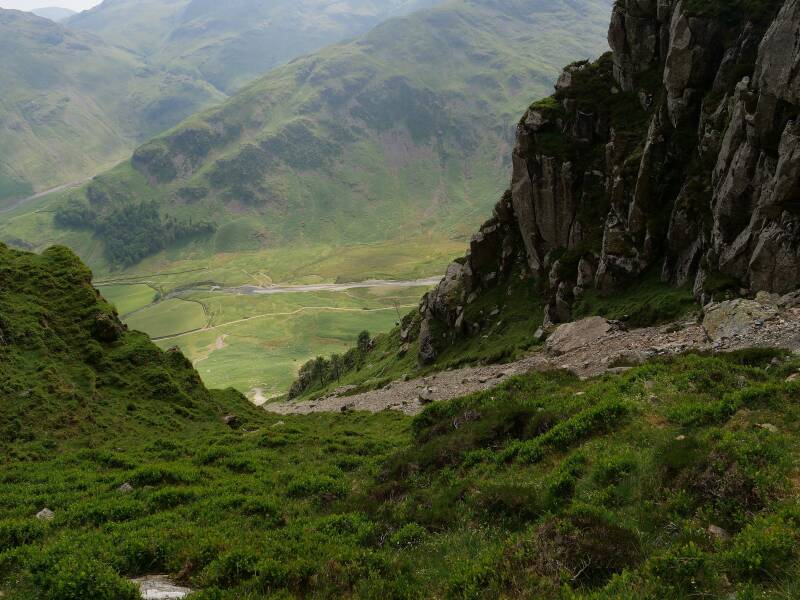
Photo below: part of the rockface close to and slightly further up the gollick, but on the same rockface, where the door-like entrance to the cave on Pike O' Stickle is, showing possible rock carvings. The black circle in the photo below has within it what appears to be a system of scratchings or markings that form a box-like shape. Could this be in some way representative of the "door" to the cave? Some Pictish and other symbols represent for example, spirit doors. To the left of the black oval or circle can be seen some possible V-like markings, although these may be natural. The white circle or oval in the photo below encloses some other possible markings, though likely natural, whilst the orange oval encloses a part of the "arrow-like" symbol shown in more detail in the photo below the photo below, which is also described in the photo description below the photo below and above the following photo in which this is shown.
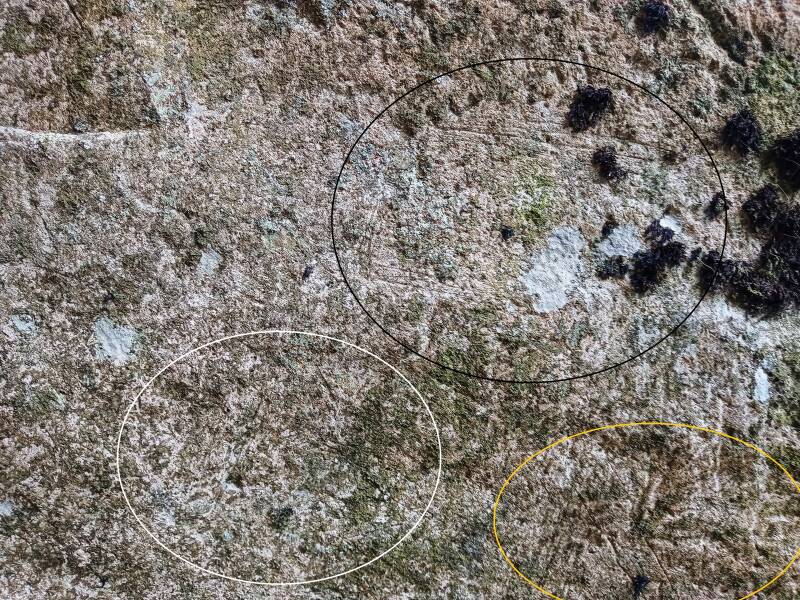
Photo below: another photo showing a different part of the rock face shown in the photo above. The white oval encloses the arrow-like marking, which looks to consist of a V shape interlocking with two lines. I am not sure if any of these markings could simply be natural, but I suspect that some of them are not, like the arrow-like marking in the white oval below. The orange ovals in the photo below circle less-obvious possible markings, which are more likely to be completely natural. The yellow oval in the photo below encloses what could be a very-vague V-like marking.
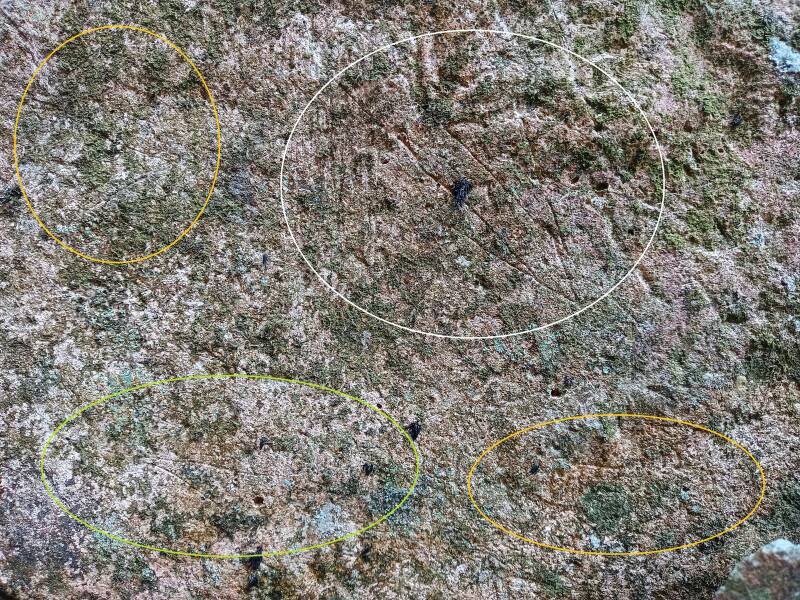
Photo below: part of the interior of the "cave" of Pike O' Stickle. The photo below well demonstrates the rough structure of the surrounding rock, with two crevice openings also visible, of which there are at least three in this cave, from what I remember, only one of which leads into the narrow second chamber which is not shown in the photo below. The aforementioned inner chamber feels especially sacred and I feel that it should not be intruded upon much. The orange circle in the photo below encloses two percussion marks which would have been created when Neolithic miners were hacking away at the hornstone.
I hope that this blog post or article was an interesting read, and it does cover a lot of topics. I hope that in the future some of the mysteries and other aspects to the subjects discussed in this blog post/article may be better understood, and that I may help to encourage some further interest in them. Although, in terms of the ancient beliefs, ancestors, gods and places - we must always respect them, and the Cave on the Pike O' Stickle is dangerous to get to, and so subsequently I do not reccommend that anyone visits there. Nevertheless, for sensible archaeologists who are brave enough to safely get to this site, and who know how to reach it and navigate it, in the right weather conditions and generally with mininum risk, these possible rock carvings discussed in this article near the Cave of Pike O' Stickle do need more research. It is probably safer to approach the site by going down the scree from near the top of the gully, but do not take this as sound advice - and generally I do strongly discourage anyone to go there.
This article/blog post is written in honour of the ancient deities and ancestors of Cumbria, and of my family. May we all be safe and well (humanity in general too).
Add comment
Comments