Written and published by Linden Alexander Pentecost, published on the 20th of February 2026, note that I have already published another unrelated blog post on this website today (the website you are currently on), and may publish an unrelated article later today on one of my other websites. This article in front of you is unrelated to and separate from any and all of my other publications, as are all my publications, and this includes this article or blog post on this page having different content, and different images from other publications in which I have discussed a little on Hen Blas. This article/blog post also contains 4 photos, the last of which was taken by me, the author, the other three of which were taken by a friend using my camera so that I could stand upon different areas of the dolmen to show its scale and structure, my friend also gave me permission to include the photos he took in this blog post, and they were also taken on my camera. This article/blog post is published only on this UK-based website, and the author is also from the UK and lives in the UK. No AI was used in this nor in any of my writings. This blog post/article contains a total of 1894 words.The photo descriptions in italics above the four photos also contain a lot of information not in the main text, and are important, as are the photos themselves. There is a small paragraph after the last photo. Some of the topics discussed in the other blog post I published on this website today are also touched upon with other unique information only in this blog post/article on this page. Yesterday I also published an unrelated article on a brand new website.
On the island of Anglesey, in Welsh: Ynys Môn, is what might be described as the largest dolmen in Britain, if indeed it is a dolmen. This structure is of such a huge scale that archaeologists in general seem hesitent to refer to it as a dolmen, but I personally think that there is ample evidence and suggestion to imply that it could indeed be a giant dolmen structure. The first three photos in this article were taken when I was 25 years old in 2018, the fourth photo was taken in 2017.
In a geological survey, the research of Mr. Edward Greenly seems to indicate that the capstone, i.e. the stone between the two supporting megaliths at the Hen Blas dolmen, seems to have been moved, and from what I understand, there is quite a strong implication that the central "capstone" was moved by people and was not placed there naturally. Nowadays I think that the position of this stone is different from its original position as it does not seem to be quite as "high up" as it may originally have been. But nevertheless, the research of Mr. Edward Greenly seems to indicate that there are glacial markings on the underside of the stone, and in the wrong direction for the stone to have been placed there by glacial action - and also, the markings are on the underside of this stone, implying that it must have been rotated and also moved upside down to be placed upon and between the two supporting megaliths - and the capstone in question which was moved is enormous, as you will see in the photos. The two giant supporting megaliths are generally understood to be glacial erratics, and these are larger than the capstone, even though the capstone itself is still huge.
Nevertheless, I think it possible that the two giant supporting stones may not be positioned entirely naturally; after all, if the ancestors connected to this place moved the enormous capstone, then they were likely I think capable of moving the other two megaliths as well. Other evidence has also been found, indicating that this site was used as a burial site, and that other stones were once present there, but I am doubtful that its original sacred purpose was just about burials.
There are also a fair number of other dolmens, and other megalithic sites on Anglesey, so to me at least it is not surprising, in a landscape full of megalithic ancestor-made structures, that this giant example could also be one of them.
The dolmen at Hen Blas is located in a position that would have once overlooked a sea inlet, but which has now become marshland. If this structure is an ancestor-made dolmen, it is likely the largest in Britain, and also larger than the Brownshill Dolmen in Ireland, which is the biggest dolmen in Ireland. The megaliths at Hen Blas are also made of quartzite, which is interesting, given the strong spiritual associations with quartz, as well as its electrical and vibrational qualities. Note that in my blog post about the Cave on Pike O' Stickle also published on this website today, I also talk about unrelated different aspects to these qualities in stone, but not about quartz.
I personally feel quite a strong connection with quartz, and in different ways it has appeared in my writings, including in some of those about Wales and inspired by Wales, including in some of my fictional fantasty writings connected to Wales, most of which I wrote years ago. Recently I also had a potent dream in which I saw a large standing stone at the head of a stone row of other standing stones, but this large standing stone was completely made of orange-amber coloured quartz. This subject of ancestors being connected to stones is also something I discussed other aspects of in the separate Cave at Pike O' Stickle blog post I published earlier today, and have discussed other aspects of in other publications recently and longer ago. But the information in this blog post on this page is unique. And so anyway, carrying on regarding the aforementioned dream - I then walked away from the large, maybe 8 foot tall standing stone of amber-yellow coloured quartz, which kind of had the vague appearance of a tall woman's shape, albeit very tall, and more pointed and crystal in shape, and walked down the stone row through mist, which was in fact a pathway between two stone rows, making it in a sense a stone avenue.
The spirit of the amber-yellow quartz-coloured standing stone in my dream, then walked down the path after me. I had stepped off the path between the stone rows at this point, and she walked past me, she wasn't seven foot tall, but more like 5 foot tall, she looked about 40, wearing a dress and a shirt both made of a wool-like material, she was very thin, almost elven or fairy-like, she was beautiful with blonde hair and freckles, I immediately thought she was a woman, but she also looked kind of androgynous in her general figure, and had blondish-gold hair. She smiled at me and continued walking along the pathway between the stone rows. In this dream, I felt that I had in a sense "met" a goddess of the stones, although I do not precisely understand what was being conveyed to me in the dream, and it felt very meaningful. I feel that the information I present here about this dream, on a spiritual level conveys something important in relation to this subject, and to the guardians of standing stones and of quartz.
In the photos descriptions in italics above each of the four photos below, I discuss lots more detail about the Hen Blas site and describe the megaliths in detail. I am also in three of the photos for scale in different parts of the megaliths, from different angles.
Photo below: a photo which a friend took of me, climbing on one of the megaliths, being one of those that would have supported the captstone, which has since fallen out of place. I am visible in the photo below as climbing close to the top of the megalith on the right, the taller one. The other supporting megalith can be seen behind me and on the other side of the tree, which obscures the view of the capstone. This photo does I hope help to demonstrate the immense scale of the megaliths at this site - they are absolutely enormous. The photo below was taken in the summer of 2018.
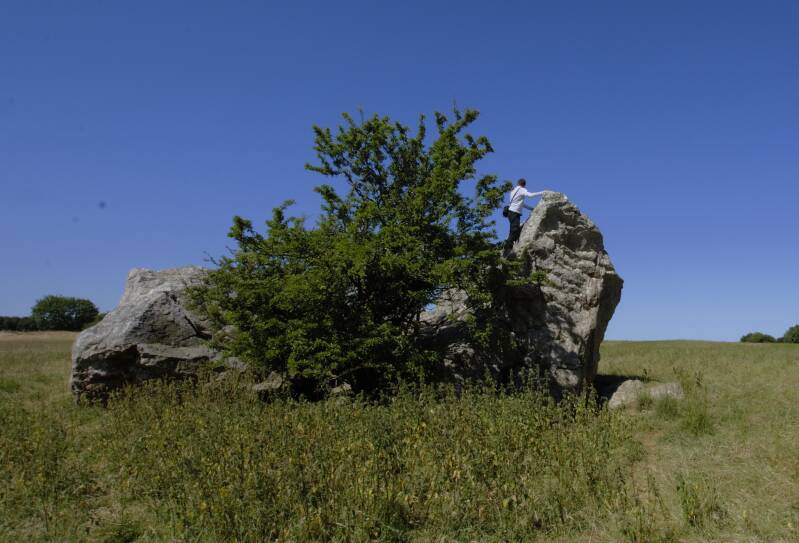
Photo below: another photo which a friend took of me from a different part of the structure and with me on a different part of the structure to again show its enormous size. The capstone, now no longer in its original position, is the enormous more-flat megalith at the centre of and towards the right of the image. On the right of the image can be seen the lower of the two supporting megaliths, whilst I am stood on the edge of the taller supporting megalith, in a different position to in the previous photo, the taller supporting megalith being visible towards the left of the image. This photo was also taken in the summer of 2018.
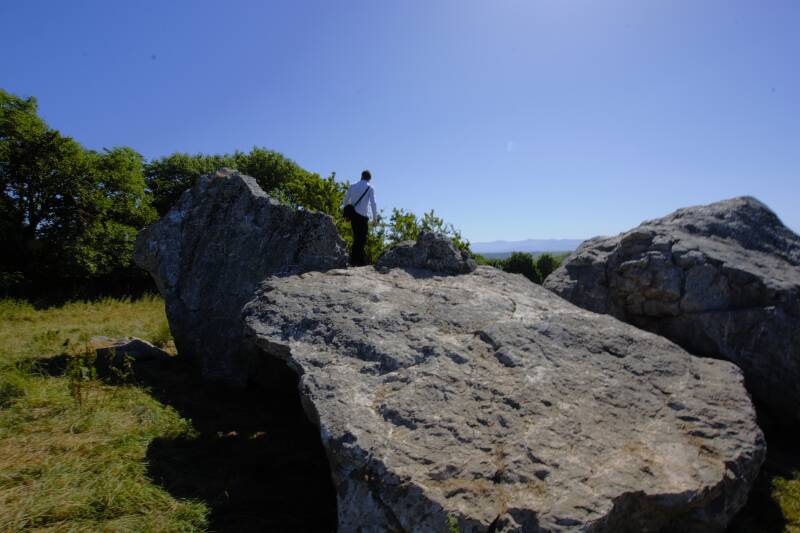
Photo below: another photo which a friend took of me, from a different angle and on a different part of the megalith, although again on the taller supporting stone. In the photo below I am sat down in a meditation-style pose whilst also balancing myself on top of the tallest megalith. The photo below also with me for scale, like in the two photos above, helps to show the immense, giant size of these megaliths. In the photo I am staring over the beautiful summer tree, vaguely towards the mountains of Eryri, which can be seen in the distance. The surrounding countryside, and light on the field, and the light on the taller supporting megalith and in the tree below it also gives this place and the immensity of its size a magical and I think holy feel. The photo below was also taken in the summer of 2018.
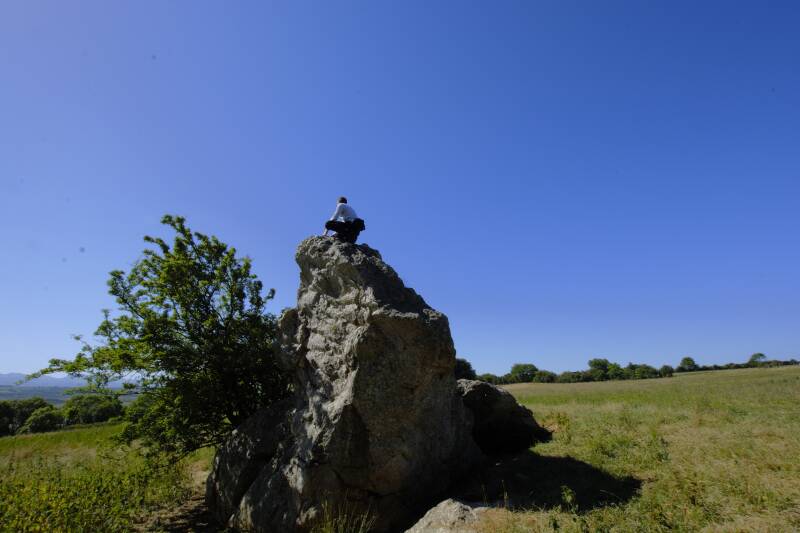
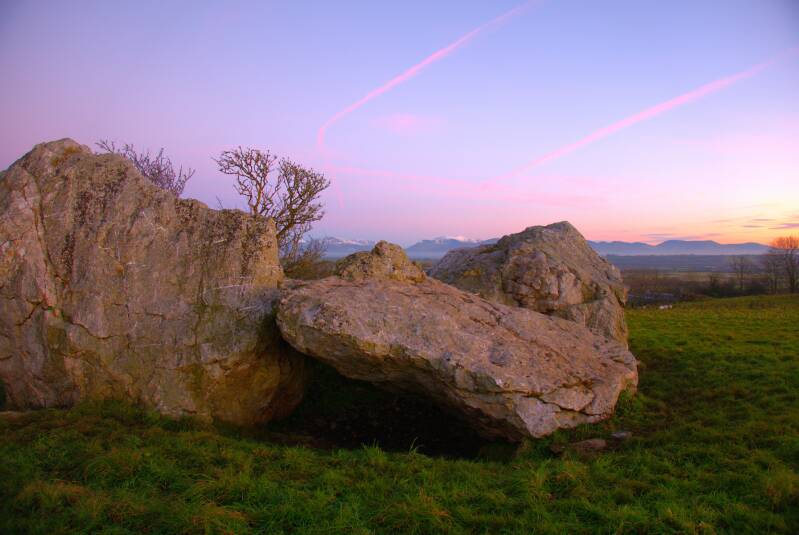
Photo below: a different photo of the Hen Blas dolmen taken by the author on a different trip to the site during winter. Note the beautiful sunset colours around the mountains of Eryri in the background. The photo below also helps to show the structure of this possible dolmen. Note also that the quartz veins in the taller supporting megalith are more individually visible in the photo below, whereas in the photos above the quartz in the stones more generally helps them to glow, albeit it not with the pinkish colour illuminating the quartz veins in the photo below.
I hope that this article was an interesting read. This article is dedicated to my friend, and to the ancestors of Anglesey/Ynys Môn/Môn. I send blessings to all. This site is truly very beautiful, but it is I believe on private land, and I ask that those who are allowed to visit it please respect this site. I do also think it would be good if more people took an interest in this site, it is truly fascinating and impressive, and is a very unique site among dolmens in Britain for so many reasons. Thank you all for reading!
Add comment
Comments