Written and published by Linden Alexander Pentecost, published on the 21st of February 2026. The photos were also taken by myself, the author. This publication is unrelated to and separate from any and all of my other publications, the written content and the photos having never been published before. This article was published only on this UK website and was published in the UK, the author is also from the UK and I also live in the UK. No AI was used in this publication nor in any of my written works. This article/blog post contains 5 photos, which are important and relevant to the text, also the photo descriptions in italics above the photos contain other information not in the main text. This article/blog post contains a total of 1775 words. I have published many things recently, including yesterday on this website and others.
The north of Lancashire is not really somewhere that most people would probably associate with megalithic monuments, and in some areas of North Lancashire, like The Fylde, such monuments appear to be lacking - to my knowledge, although I may be wrong. However, limestone areas of North Lancashire, where Lancashire borders with Cumbria and North Yorkshire, are quite abundant in megalithic sites. The area around Carnforth is one such region. Some of the megalithic sites around Carnforth are, generally speaking, accepted by mainstream archaeologists as being ancient megalith sites, although for some reason these sites are not really talked about by people in general, except for myself that I know of. One example of a very impressive megalithic site near Carnforth is Hunting Hill, a hill surrounded with and intersected by large megalithic walls, with a possible passage tomb type monument on the top, and other features.
I have described and published about a large number of these sites in the past, of which there are many, including those in nearby areas of Cumbria. I have discussed some of the sites in that area in blog posts on this website, including making a relatively recent specific group of references to some possible sites I noticed over Christmas around Leighton Hall. Well, this blog post on this page will not focus on those sites, or on any I have published about previously, rather I will discuss various other possible megalith sites in the same area.
The first area is near Warton in North Lancashire. Below Warton Crag itself are a number of fields on private land. I only was able to visit there around 8 years ago, although until now I have not written about this site nor included photos of it (nor have I done either previously for the other sites I discuss in this article). Within this field are a number of collections of large, mainly limestone rocks, some of which appear in formations that make them appear like kist tombs or small passage tombs. They could also of course result from field clearance in a later period, although this does not immediately explain why some of them are in passage-grave like shapes. Given the megalithic walls and possible passage grave very close by on Hunting Hill, I would say there is a fair chance that the structures below Warton Crag could be megalithic structures too. The nearest sites to these possible megalithic structures, would be the possible stone circle and cairn on Summerhouse Hill, a possible megalithic row or barrow near Crag Foot, the features such as stone alignments, possible standing stones and a possible stone row near Leighton Hall, the possible stone alignments on Warton Crag itself, Hunting Hill, and a giant wall structure on Warton Crag itself. There are other possible ancient sites within this area and a very short distance further away which I have discussed elsewhere. The "Cotestones", a group of large stones partially submerged in saltmarsh pools not far from Warton, may also represent an alignment of some kind, although these stones do not have such a profound megalithic structure-like formation. There are also several caves on Warton Crag, some of which have an ancient human history, as well as copper and ochre mines, with it being possible that some of this mining could have started in prehistoric times.
The possible passage tomb or cairn-like megalithic structures below Warton Crag, are located approximately at the GPS coordinates : 54°08'32.9"N 2°47'16.5"W . Since this site does not yet have a name, I will name them for academic purposes: "The possible megalithic structures beneath Warton Crag".
Photo below: one of the passage tomb-like structures at "The possible megalithic structures beneath Warton Crag". The one in the photo below is less substantial looking than the one in the second photo, but nevertheless possesses a kist tomb- or passage tomb-like shape. I do not remember exactly how many structures there are like this in this area, but I think there are two. Further away from the structure in the photo below and across the small valley, can be seen another, less passage tomb-like arrangement of stones.
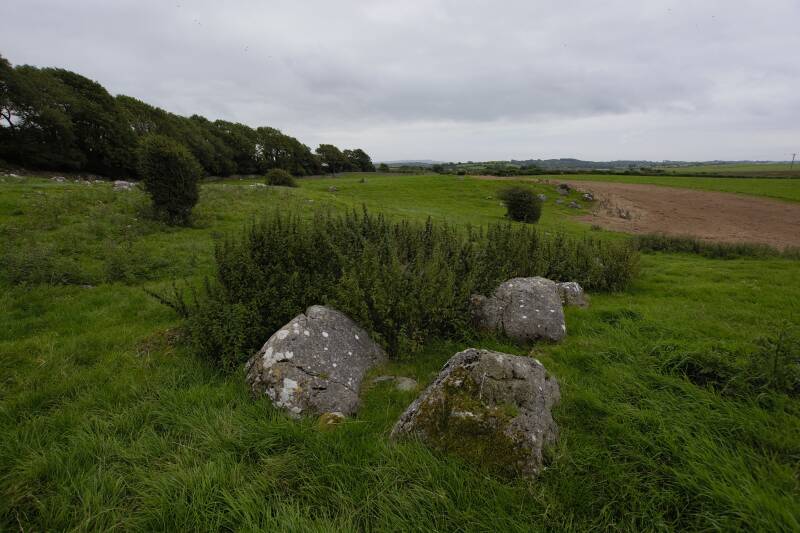
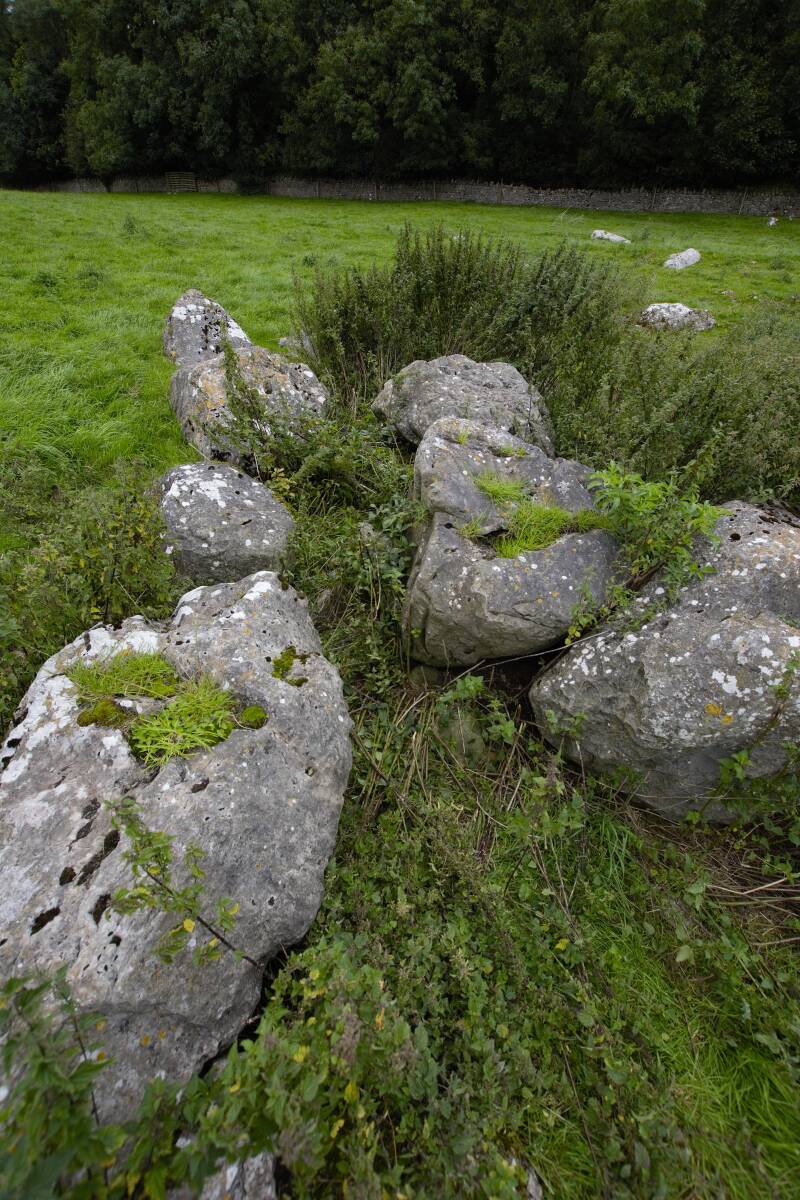
Photo below: one of the collections of large stones at the "The possible megalithic structures beneath Warton Crag" site, note the way in which the structure is narrow and in a sense crude, but nevertheless looks similar to a kist tomb or passage tomb. The megaliths in the photo below are of a fairly large size.
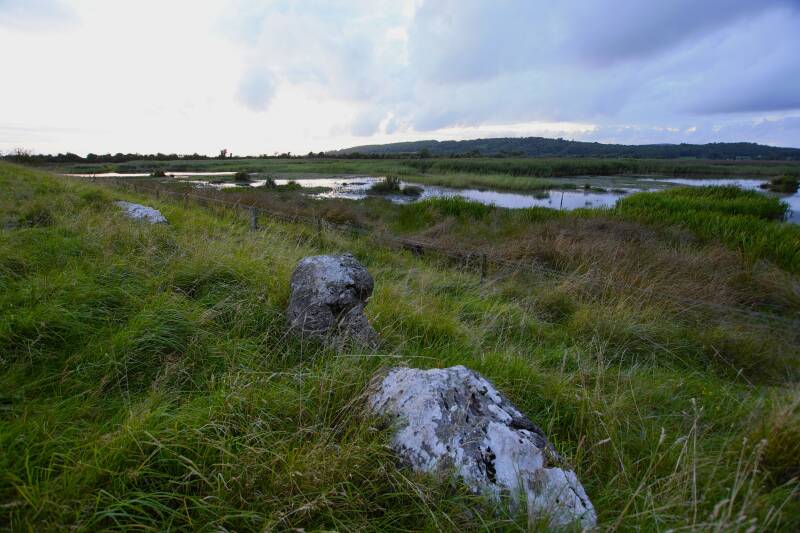
Located not at all far from "The possible megalithic structures beneath Warton Crag" is another possible megalithic structure which I added to megalithic.co.uk some years ago, under the name Ings Point, and to give the full academic name of this site which I have chosen, I will call it "The Ings Point Possible Prehistoric Structure". This site consists of a small hill, perhaps natural, with a line of stones, not a megalithic wall but a kind of stone row set into one side of the hill. In some ways it resembles a long barrow, but it also somewhat resembles a less-complete and far smaller structure akin a little to Hunting Hill and the megalithic walls that surround it. The link to the entry for this site on megalithic.co.uk is: https://www.megalithic.co.uk/article.php?sid=55212 although the given web address does not contain the details about the site I am including in this article in front of you. Lidar maps that cover this site do not appear to indicate any kind of barrow or passage grave within the hill, although Lidar maps are not always helpful for identifying such features. This site is located at the GPS coordinates: 54°09'03.1"N 2°47'53.2"W . The photo below (with description above) shows this site.
Photo below: the stone row, or group of megaliths which seem to be built in a row into the bank of this hill at Ings Point. Note the proximity of this row of stones to the saltmarsh's waters, and how at one point this would have been the sea, whereas at other points the sea level would have been far lower.
The third area, or rather two areas around the same village, I want to discuss in this article is located near Yealand Storrs. This is not any of the sites around Leighton Hall, although it is not at all far from there, nor is it far from the possible stone rows I have discussed in other publications near Cinderbarrow, nor is it far from the possible ancient sites at Hawswater I have previously discussed in a lot of details across many other publications. The features at Yealand Storrs include possible ancient, or later, stone alignments, located at around the GPS coordinates: 54°10'42.5"N 2°46'36.0"W , and other stone alignments located around the GPS coordinates of: 54°10'36.1"N 2°46'32.3"W , which appear to be a kind of "curving" stone row or alignment. If both these sites are ancient then I think that they could be connected, but the first set of coordinates that relate to a site on a small rocky ridge, may relate to a site where there have been some later quarries and wall building, however some of the stones there do look as though they form an alignment. The second set of coordinates I give relate to possible aligned stones within a more open area, and these stones have no doubt been in situ for a very long time, and I think do some extent at least, ancestors moved and positioned them. I have only included pictures in this article that relate to the second set of coordinates in the system of fields, and I have not been back to this area for a while & so have no photos relating to the first group of coordinates in this third area. The second group of coordinates for this area relate to a place where a public footpath goes near, but I remember feeling quite intimidated by the cows along that path, so if you plan to visit, please take care to be safe from the cows. The two photos below (with descriptions above each) show parts of this site that the second set of coordinates relate to. This site I will simply name "The Yealand Storrs possible stone alignments".
Photo below: some of the megaliths in the second (lower, in the field) area of the "The Yealand Storrs possible stone alignments". Note how the megaliths behind the megalith in the foreground appear to turn towards the right in their alignment.
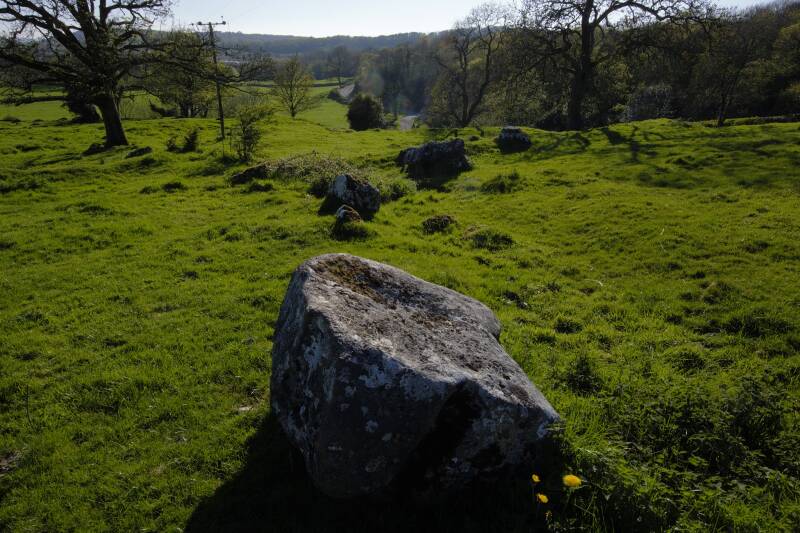
Photo below: looking uphill from near where the photo above is taken, showing the upper part of the lower part of "The Yealand Storrs possible stone alignments". Note how the alignment visible further away from the two stones in the foreground shows a line of four stones going up the hill, at least two of which, possibly three, could be considered as megaliths.
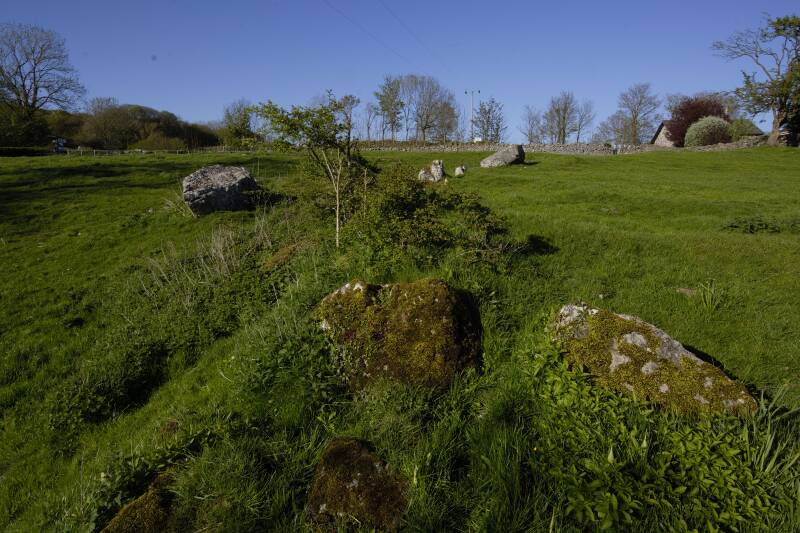
I hope that this article was an interesting read. These places in this article are arguably not the most impressive possible megalithic sites in that area, although the first photo of a passage-tomb like structure does show an impressive passage tomb-like collection of stones. Nevertheless these sites are really interesting and do need more research I think. The lower part of the area at Yealand Storrs as shown in the two photos above is also really interesting, and I would be interesting in the future to know how it could connect to other sites closeby. But, if you visit, beware of the cows, they are beautiful creatures but can also be dangerous to humans. This article was written in honour of the ancient ancestors of northernmost Lancashire, and of my family.
Add comment
Comments