This article/blog post was written and published by Linden Alexander Pentecost on the 24th of February 2026. This publication is unrelated to and separate from any and all of my other publications, and contains different content from them. The four photos in this article have also not been published beore. The photos in this article/blog post were also taken by myself the author, Linden Alexander Pentecost. No AI was used in this publication nor in any of my writings. The photos, and the photo descriptions above the photos, are also important alongside the main text, with the photo descriptions in italics containing information not in the main text, and the photos themselves are of course important too. This article/blog post contains a total of 2151 words.
I have only been to the island of Islay once, during a time when I was having an online relationship with someone. In my article being published soon, on a different topic and on a different website, I will also discuss part of a related Romantic experience (this is discussed near the end of this article on this page), but the two discussions are not the same, and the content and subjects of this article on this page, and the one being published soon, and the photos, are entirely different and unrelated. The memory of me being on Islay is somewhat painful because of how that relationship ended. Islay is one of the few places I have been in the Hebrides which I have not really thought or written about that much due to the somewhat sensitive memories I have surrounding it, remembering that when I was there, I had this connection with someone, and was simultaneously trying to understand a lot of ancient history. I have written about Islay Gaelic and ancient history in quite a lot of detail however, but as of yet have not really discussed much on the island's prehistoric monuments themselves.
Photo below: a photo of the Cragabus Chambered Tomb, with one of the kist-like chambers visible the foreground, and one of the humanoid-looking standing stones to the back. The photo was taken in May 2019, and during beautiful weather.
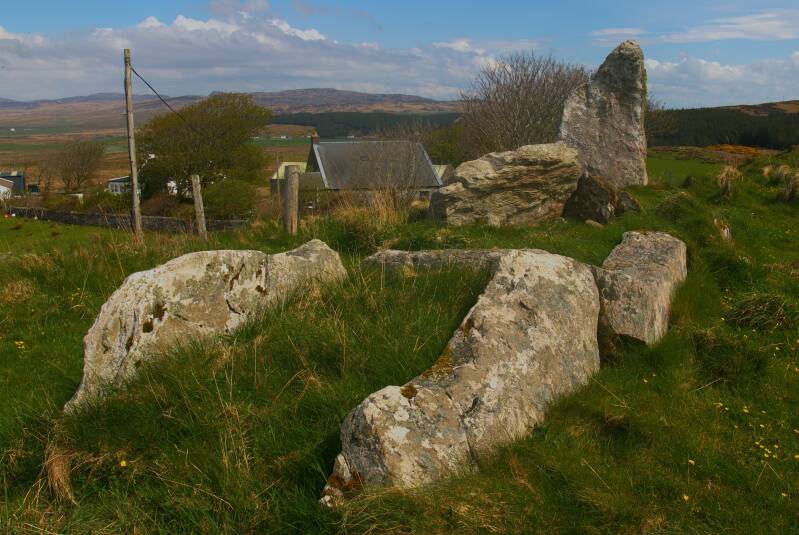
The chambered tomb at Cragabus is located in southwestern Islay and on the Oa Peninsula. The tomb, in many respects shares a similarity to the chambered tombs of southwestern Scotland, including in some respects to the tombs at Cairnholy for example, which I have discussed in-part in another blog post on this website. The chambered tomb at Cragabus also contains two standing stones, both which have humanoid-figure shapes, rather like cloaked figures. The thinner of these standing stones resembles similar priest-looking or wizard-looking standing stones in parts of Kintyre, Colonsay, parts of the Outer Hebrides and Northern Norway, as I have discussed somewhat elsewhere.
Various pieces of flint were found at the site, although much of it seems to have been destroyed, and one of the standing stones may have had another beside it, now missing. It is unclear who built this site, and how these people might have related to the previous Mesolithic and Upper Paleolithic peoples of Islay. There is also, as I have implied elsewhere, the possibility that Islay was occupied before the last glacial maximum. These type of chambered tombs are common in much of Argyll. Personally, I do not really believe that the Mesolithic and Neolithic peoples for example, just represent different periods and cultures on a linear time scale. I think rather that they represent different ancestral groups and spiritual communities, who did not replace each other, but who perhaps lived alongside each other, through different periods of expression. As I have implied elsewhere, I also do not think that either of these peoples truly "died out", but it is hard to trace or to say what aspects of our languages and cultures today connect specifically more to the Neolithic peoples, and which to the Mesolithic.
I personally really liked this Cragabus Chambered Tomb site. I visited when on a fairly long walk towards the southwesternmost part of the Oa Peninsula. The energy of the site felt very spiritual, calming and somehow reassuring. I spent a fair bit of time there, but would happily go back and spend more time there.
Photo below: another shot of the humanoid-looking standing stone, visible from a more distant angle in the photo further up this article. I love the way that this figure stands against the beautiful late spring skies and moorlands behind. This figure stands proudly and peacefully, and I admired it as the birds sung and the wind blew, where small flowers were growing from the wild ground. It took me mentally (not literally) in the sense of ancestral time and space that existed on these islands, in the times that gave rise to the Hebridean traditions of magic and mythology which later became expressed in the Scottish Gaelic language, and specifically in its localised dialects, the dialects of Islay being particularly interesting and unique, for information on this, please see my other publications about these subjects.
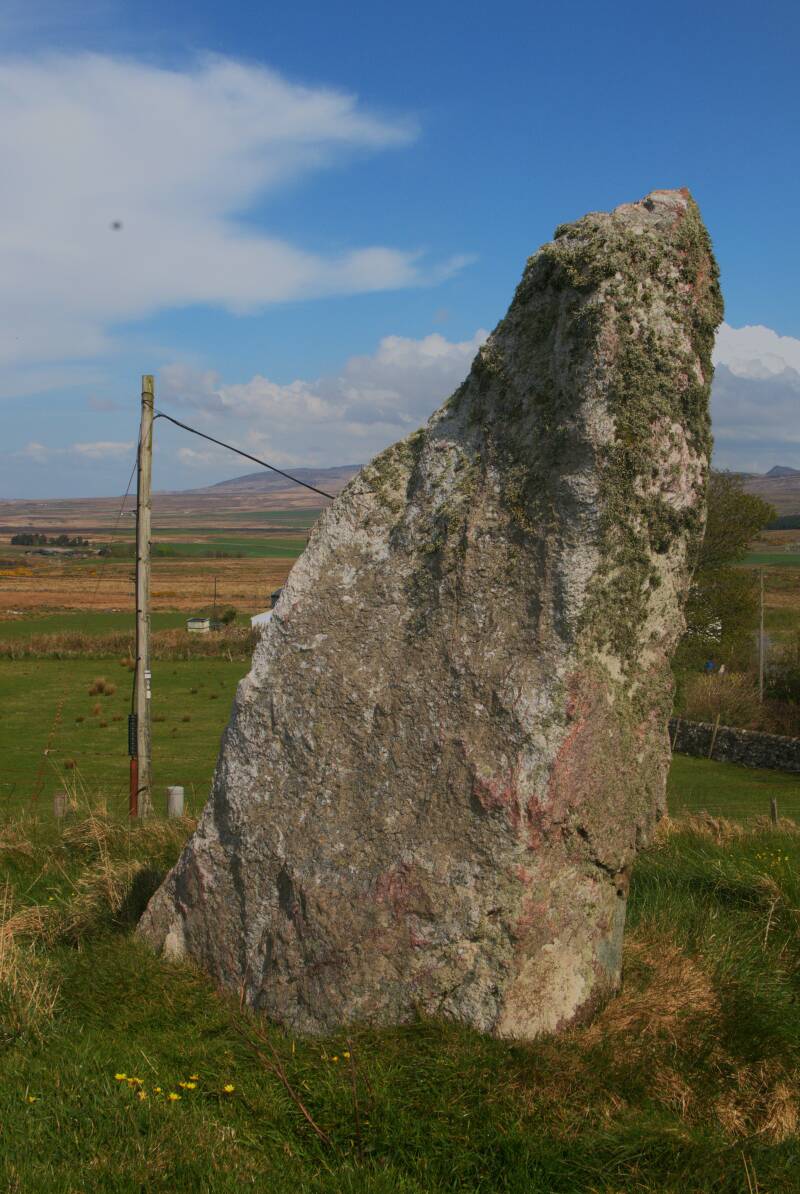
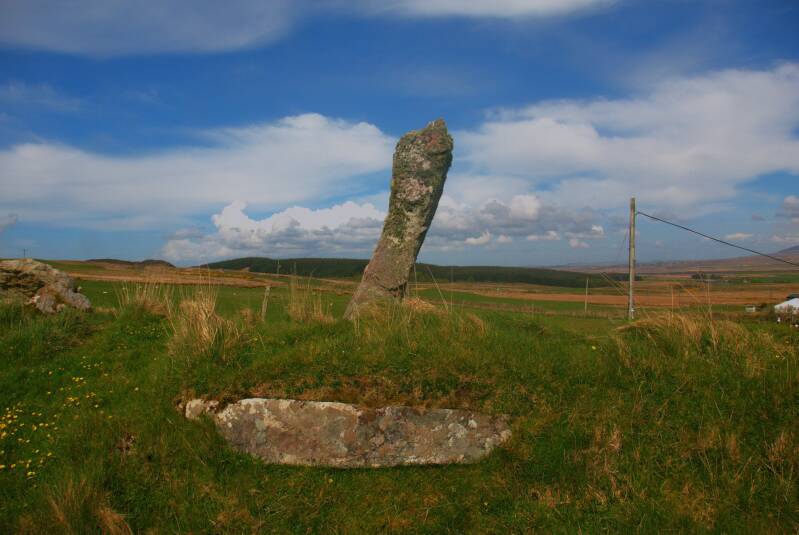
Photo below: another standing stone at the Cragabus Chambered Tomb. From this angle, the stone in the photo below also resembles a human figure, and is specifically similar in shape, with it being wider at the top, to various stones in Norway, as discussed in another blog post, but also specifically it shows similarity to a standing stone on Colonsay, to several on The Mull of Kintyre, to one on Barra, and to several on South Uist, and also to some extent to the Clach an Teampall standing stone on the island of Taransay. I personally am of the view that these specific standing stones represent an ancestral founding of knowledge and protection within the landscape, that they are there to guard and watch over, and I personally think that they may not represent the exact same group of ancestors as those who created for example, the tomb structure as a whole at Cragabus on Islay. I have discussed another of these guardian, protection stones of a similar appearance, which is located on Barra, in an unrelated print-only book publication, which I published last year (one of two print-only book publications I published last year).
When on Islay in 2019, I also noticed another standing stone, known as the Uiskentuie Standing Stone, to the south of Loch Gruinart. Loch Gruinart is a really interesting sea loch, being very sandy, and resembling somewhat the Kyle of Tongue on the northern coast of Scotland. From my understanding of the geography and sea level changes on Islay, Loch Gruinart would have once been deeper, and would gone further south than it does now. Marshland to the south of Loch Gruinart has also been drained and irregated at some point, but the higher sea levels of the Mesolithic period would also have meant that the sea would have gone south of the marshland and would have almost, if not entirely connected with the bay to the south. A spit of land, perhaps a glacial morraine formation, may well have stopped the ancient Loch Gruinart from fully connecting to the bay in the south, although the low area of land does bypass the morraine formation to the east, meaning that at least a part of the Ancient Loch Gruinart would have connected to the bay to the south. The settlement of Uiskentuie lies around the edge of what would have been this ancient channel of seawater, and upon the morraine formation closeby is the Uiskentuie Standing Stone. Whilst I did not walk to the standing stone, I did sight it from the road when heading back from Loch Gruinart and going back to Bowmore, in a taxi with my family. And also drinking a small amount of whisky, not the taxi driver, of course, but I sipped some. The taxi driver didn't mind and was honestly an incredibly cool guy.
Photo below: the Uiskentuie Standing Stone, clearly visible as being upon the likely-glacial morraine embankment, above the clearly visible ancient water channel visible between where the photo is taken and the standing stone, which would have most definately connected the Ancient Loch Gruinart to the north, to the bay to the south, just visible behind the bank to the left.
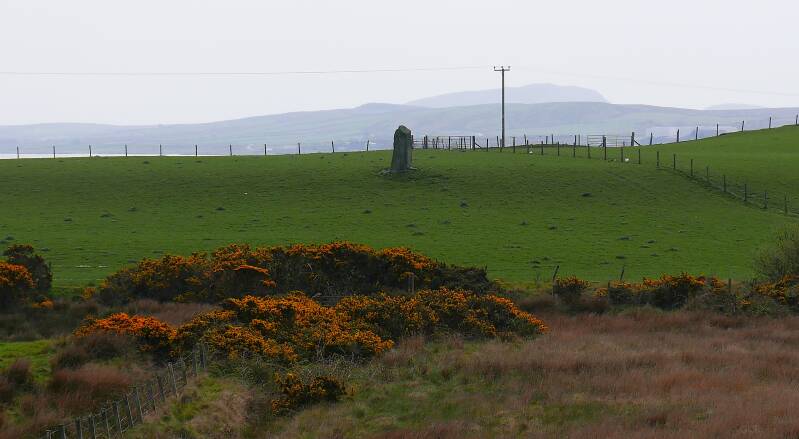
A thing which makes me particularly curious about this standing stone, is the fact that it lies so close to what would have been a seawater channel, as I have described. The standing stone may have been set into its present position during a time when Loch Gruinart was still further south, and when some kind of channel may still have connected the Ancient Loch Gruinart with the bay to the south. As I have discussed elsewhere in detail, including elsewhere in other unrelated blog posts on this website, there are legends, as well as I think, lots of other evidence in Western Scotland of massive alterations in the geography, which, if the legends are to be believed, sometimes happened dramatically, causing tsunamies and flooding. These may be related to, but separate from the Storegga and other tsunami events which affected eastern Scotland.
And in terms of some of these standing stones, and their locations, well, those in Western Scotland anyway, I sometimes feel that they were "left" there as guardians, somehow in relation to these dramatic events in Scotland's mythological and ancient past. Not all of the standing stones, but some of them. Imagine that some events happened, which in a sense destroyed much of the ancient landscape and world. And that the importance of these events was understood in a greater context, it was understood that the ancient world had passed, that much was lost, and that the new world would be so vastly different. I feel that the divine ancestors, akin to in some senses, and connected to, to the ancient Finns, the Atlanteans, the Viracochas, the Apkallu, to the deity Quetzalcoatl, were sad and distraught for what happened. I feel that they knew they had go leave, that they could only watch the world for thousands and thousands of years, and remain unseen. And that there was a great sadness about this, a great sense of loss.
I feel on some level that again, some, but not all of the standing stones in Western Scotland, were left there, as parts of them, aspects and expressions of those divine ancestors, with the specific purpose of watching over us, the stones humming and singing on a frequency that even most experts on megaliths, and psychics who study the stands at other standing stones generally, cannot hear or even notice the music and voices and presence of these particular standing stones. And when I say voices, I do not mean to say that I have actually heard these stones talking when I have been to them in the sense of sound and language that we would hear and experience in normal interactions with other physical beings and with the physical environment. But stones do hum and have a music. You can't quite hear it with your ears as a distinct sound, but it is there, and your ears might interpret it as a strange silence, which feels somehow not silent, concealing something, a silent ocean of music, just outside of what our mind is normally able to perceive.
I hope that this article was an interesting read. Note that, soon I will be publishing my brand new website's second article (this is not in reference to the website that this article on this page is on, nor is it in reference to my other websites that began before this one did and which I still publish on, but is rather in reference to my new site: www.kielimatka-2-11.co.uk . ). The second article on www.kielimatka-2-11.co.uk (the one being published soon) will be about a petroglyph site in Northern Norway, and will be unrelated to any previous publications, including those that discuss Narvik and its languages. In the article being published soon I also refer to another romantic time in which I felt sad, but whilst the experience was related to the Romantic time discussed in this article in front of you, they are not the same experience, and the way I discuss each is in regard to very different feelings. This article on this page is written in honour of my beloved grandparents, and of my my mum, who I went to Islay with, and to my dad, and to the ancestral guardians of Islay, to the ancestors of Islay, to the people of Islay and to all the island's other living things and beings. May we honour those ancient guardians, and respect them, and heed to their wisdom.
Add comment
Comments