Written and published by Linden Alexander Pentecost, published on the 25th of February 2026. This publication is unrelated to any of my other publications and no AI was used. This article/blog post was published in the UK and the author is also from the UK and lives in the UK. The photos in this article were also taken by myself, the author. The descriptions in Italics and the photos themselves contain important information not in the main text. Note that I have still not published my article on a different website about the Brennholtet petroglyphs, which will be published later this week on my brand new website (not the website you are currently on). This article/blog post contains a total of 2002 words and 13 photos, which, like the written content of this article, have also not been published before.
Near the Fairy Steps, near Beetham in Southern Cumbria, are a number of strange sites, displaying what appear to be walls, or cairns, possible megalithic structures and other features. I have discussed some of these in other publications, but there is a lot to see in this area and a lot to discuss which I think needs discussing, which I have not covered in other publications.
First of all, the Fairy Steps are a site connected to a mythological tradition about fairies. People nowadays very often, to my annoyance, laugh at the concept of fairies, assuming them to be beings of fantasy, not to be taken seriously, things that they might see as being "ludicrous" even. We have phrases like "away with the fairies" and such, which actually originally meant something different, but the phrase has come to basically mean being imaginative and disconnected from reality.
But the reality is that fairies are not something to be laughed at. Our ancestors certainly did not laugh at them, and they understood them as being, in essence, divine beings, connected to our ancestors and to other worlds. The Fairy Steps near Beetham likely takes its name from some association with these beings, the Fairy Steps being two sets of stone stairs which ascend two rocky limestone cliff faces. Below the lower set of stairs, a straight path leads down for a significant difference into the lower landscape. There is a tradition, although not proven, that coffins were taken along this route and over the Fairy Steps. In any case, we seem to be seeing a tradition that associates a "pathway of the dead", a kind of straight ley-line, with a sacred group of crags associated with fairies, there often being an association between the fairies and the spirits of the dead and ancestors, although fairies are not in my opinion the spirits of the dead, as such, but are I think connected to them.
The area around the Fairy Steps is full of likely megalithic and ancient sites, many of which I have published about. But some of these particular sites, in the area of woodland below the Fairy Steps, are really very strange, and very hard to interpret. In this area of woodland, there is at least one quarry site, to the south of the path towards the Fairy Steps. This quarry is sometimes referred to as a "marble quarry", but in fact it simply quarried hard limestone. The quarry was active in the 1800s, likely earlier and also a little later. The quarry is obvious, with obvious faces. Note that I have decided not to include grid references in this article in this such public place, because some of the areas are on private land.
Photo below: a curious line of large limestone megaliths in the woods. Does this result from natural causes, did quarrymen "move" these stones or quarry the others away, or were these rocks somehow moved by the ancestors?
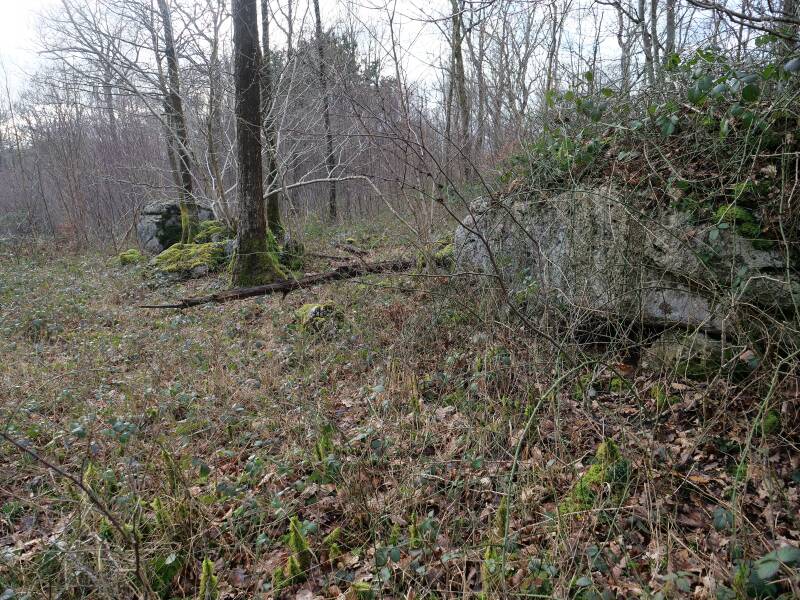
To the north of the path below the Fairy Steps, LIDAR maps clearly define two other quarry areas, which are smaller and which seem, at least in part, to be of earlier origin. Close to the upper one of these quarry areas is a hidden, forested landscape of megaliths, likely glacial in origin. Some of these megaliths are huge, and in certain cases, they seem to form clear lines or rows, but there are also many areas where the rocks are more jumbled and harder to interpret. Closeby, are several examples of megaliths which have been altered in a very peculiar way. It appears that, either, in some cases, different megaliths have been positioned together, so that one leans onto another, whilst other megaliths appear to have been broken, the upper part of them then having been slid off, to lean against the lower half, to create a dolmen- or propped stone-like construction. It is very difficult to tell if these megaliths are natural, or have been altered by people, but I very much doubt that they result from the action of quarrying, and this would make no sense.
Above the upper quarry and close to these "megalith-like" structures, are extensive areas of what appear to be walls or piles of stones. These, presumably, have in-part been quarried from the ground at some point, but why they are distributed in the way they are, in piles, and in walls, even in one case incorporated into a megalithic wall, does not make a great deal of sense to me. Many of these piles of stones do look as though they have been quarried from the limestone, but were they quarried to be used as cairns and in walls, rather than for the material itself? And would this explain why extensive piles of stones and walls, some of which resemble burial cairns, are left in situ?
I considered the possibility that later path building or even road building for forestry could be the cause of some of these walls, and indeed there are in places pathways between these walls which a vehicle could drive through, and there are modern examples of this in the area. But again, this does not really explain the formation of these walls as a whole, nor does it make complete sense of the angles, nor the megaliths placed within some of them. Above the megalithic wall in question, there is another quarrying area, where it appears that larger slabs of limestone were removed, and with some left in situ. But again, if this is where some of the megaliths come from, why were they incorporated into the nearby walls?
Photo below: a dolmen-like structure, likely resulting from a lump of limestone being cracked, but then possibly being re-arranged and perhaps supported with another rock. Was this the result of more recent quarrying or could it be prehistoric?
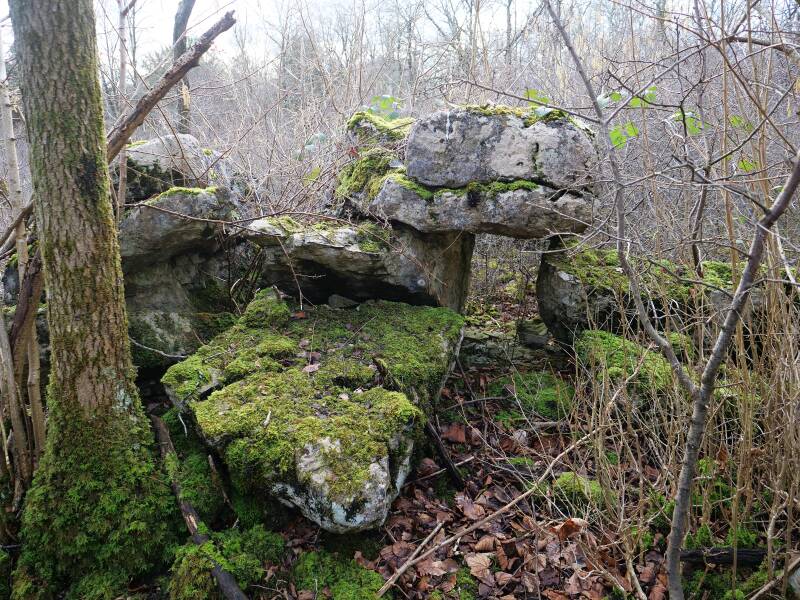
Photo below: the largest propped-stone like feature at the site, which appears to be formed from more than one megalith. Could this be entirely natural or could it have been altered in some way by the ancestors?
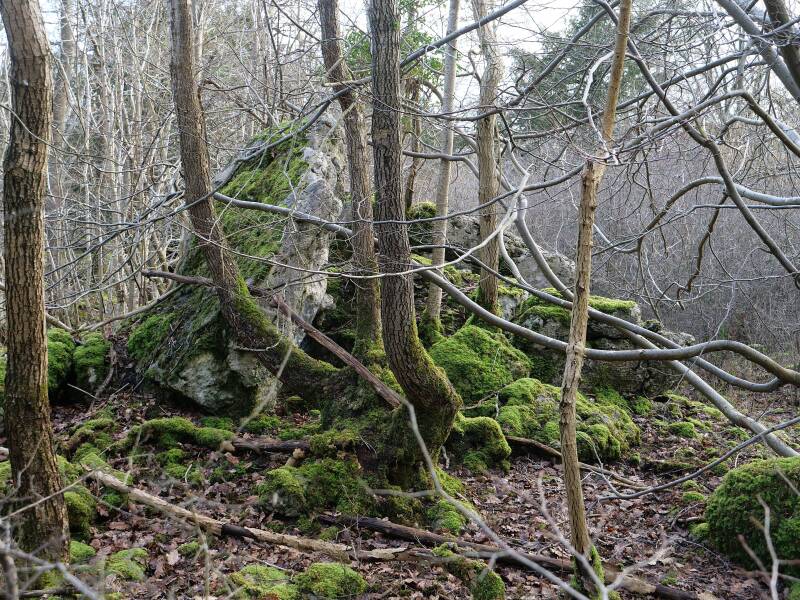
Photo below: one of the propped-stone like features visible close to one of the seemingly later quarries, this one is smaller than the one shown in the photo below this photo below.

Photo below: another of the propped-stone type structures immediately above one of the later quarries, but I do not think that what is shown in the photo below results from quarrying. This structure is of impressive size.
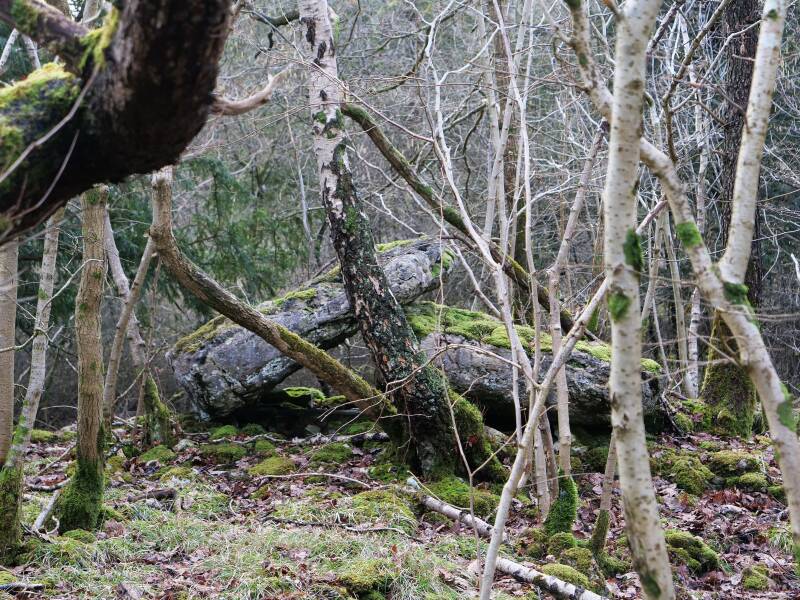
Personally, I suspect that this site has multiple periods of history. The giant blocks of limestone, some of which are in rows, and the formations of some of these limestone blocks, are in part I think from natural causes. But the alignments of some of these stones, and the way some of them appear to have been deliberately broken, and reconstructed to appear like dolmens, may well not result from natural processes. Some of these propped-dolmen type structures could result from quarrying large slabs of limestone, but their precise positions make this to me seem unlikely. The piles of stones, some of them could result from later quarrying, but the complex walls do appear to be very old, and the incorporation of megaliths into them is quite strange. Some of these walls also look, as I said, like burial cairns, whilst some of the longer piles of stones resemble some form of collapsed chambered cairn, as I have discussed in other publications.
Photo below: a prehistoric cairn-like structure, connected to the walled area and megalithic wall shown in the three photos immediately below the photo below.

Photo below: a larger, wider part of the wall or pile of stones, which connects to the megalithic wall shown in the two photos immediately below this one. Could this result from quarried material being moved out the way, or could it be prehistoric?
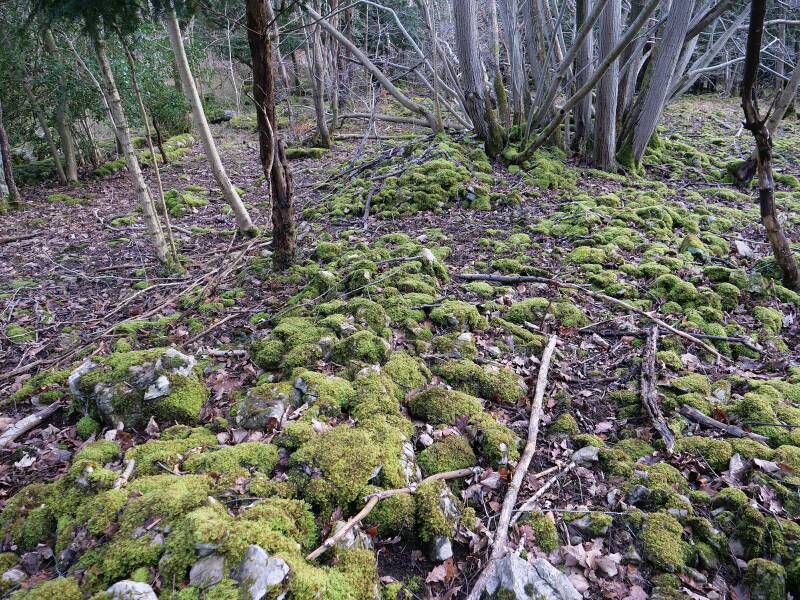
Photo below: the megalithic wall, made of larger slabs of limestone and of smaller rocks, located above the main area where the cairn-like and dolmen-like structures are. This wall is also connected to the wall shown in the photo above, but in the section shown in the photo above there are fewer megaliths.
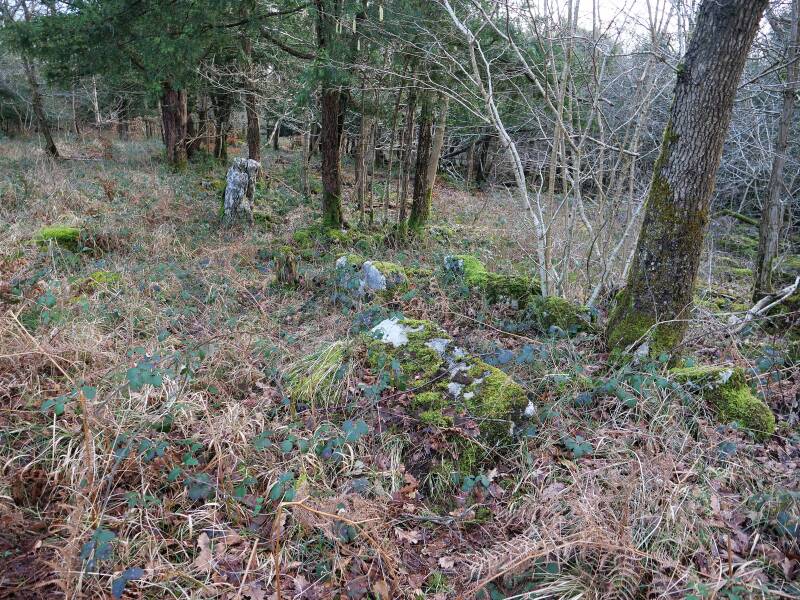
Photo below: another shot of the wall with megalithic blocks within it, which runs for a fair distance through the woods. Did quarrymen simply build this wall for some reason, or is it prehistoric?
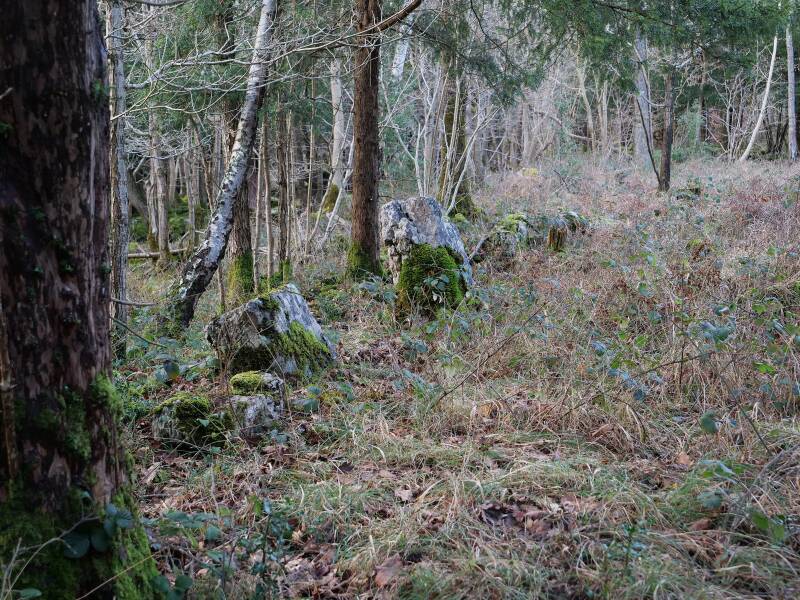
That later quarrying likely happened at this site is a high probability. This is I think indicated by the clear quarry faces in certain areas, which resemble those of the nearby "marble quarry". But I wonder, if some of the other features of this site also result from quarrying, could they rather result from ancient quarrying, rather than from later quarrying?
Photo below: a collection of erratics, or a large single broken erratic, none of which are made of limestone. Was this some kind of location where an erratic was broken up, or is it a burial cairn? This is located above the "marble quarry".

Photo below: walls near an area of small quarrying and/or cairn-like structures, which appea to come off a pathway of track leading down towards the "marble quarry" from the woods. Could these stone walls simply result from creating a road or pathway in older quarried material, or are they ancient?
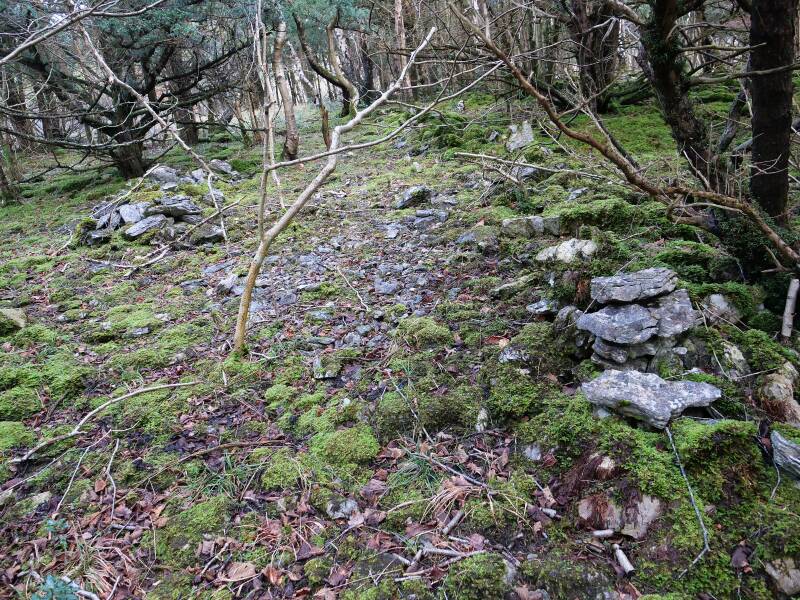
Photo below: a curious line of stones close to the "marble quarry". This line of stones appears to be aligned to a large stone on the limestone pavement behind it. What is shown below is hardly a complete stone row, but is nevertheless interesting.

I once held a belief about this site, that these stone wall features could be chambered cairns, and that the propped-dolmen type features could be indeed ancient dolmen-like structures. But I am now well aware of the quarrying which has taken place in this area in the past, and this has caused some doubts to enter my mind about whether or not any of this stuff at this particular site, is ancient. Nevertheless, I feel instinctively that the place has a lot of history and mystery, and I am not quite convinced that all of these features, and indeed all of these quarries, are modern.
Furthermore, as I have mentioned, there are many other ancient sites in this same area, and at the base of the area of woodland, is another curious site. It could result from a glacial moraine and from an accumulation of stone material below the site of those rows of giant blocks in the woodland, but it does also look strongly akin to a kind of megalithic monument.
Photo below: the cairn-like feature in the field below the other sites. The gate post slab in the foreground was likely added later. A natural collection of boulders, or a kind of sanctuary or sacred site? Some of rocks are very large and have clearly been there for a very long time, judging by the levels of erosion.

I hope that this article was an interesting read. Thank you for reading.
Add comment
Comments