This article/blog post was written and published by Linden Alexander Pentecost, and was published only on the 26th of February 2026. This article is unrelated to and separate from any and all of my other publications. No AI was used in this nor in any of my publications. This article was published only on this UK website, and I, the author am from the UK and live in the UK. The photo descriptions in italics contain important information not in the main text. The photos, like the rest of the article, have also never been published before, and the photos in this article (three in total) were also taken by myself, the author. This article contains a total of 2095 words. Note that there are other sites like this which are shaped in certain ways in other parts of the Morecambe Bay area, including at Heysham, which I have discussed elsewhere. Note that I have also discussed many other, separate aspects to these topics, in many other recent publications, and in many older publications. Note that two of the four stones discussed in this article are located at the same site, and that I discuss one more than the other, because I understand the appearance of one of them more, along with the two other stones at other sites, four in total.
Today I wished to discuss four other examples of stones, likely of ancestral significance, with shape and forms that resemble either human forms or the forms of animals, although to think of their physical shapes as representing humans or animals alone is not in my opinion correct. I think rather that their shape, sometimes through the working of ancestors, or through natural causes, represent divine beings, beings that may have shared attributes with certain animals, or sometimes humans, but which were not earthly beings in the same sense that our physical forms are.
Not far from Cartmell in southern Cumbria, on the Cartmell Peninsula is an interesting rock, or small megalith, called The Toad Stone. In Ancient Egypt, the Ogdoad are a group of eight primordial deities. These beings preceded the reality and creation of the world of Ancient Egypt, they connected to a much earlier, primordial world, a wetter world.
When we look across mythology we find similar tales. Sky birds fighting serpents, in Northwest Pacific indigenous beliefs, often it is the Thunderbird carrying a whale across the sea. Many traditions talk of a time when the surface of the earth was wetter. Before the vast deserts were formed, turning this primordial world of mud into rock and mountain. Even if not taken in the sense of having literally been mud - matter was more malleable. The ancients could use sacred songs and sound to alter the world. Then it became more solid, and we came to be as we are now. The ancestral time, the primordial time, still exists, for time is not linear. But we are out of sync with it. The ancient Old Ones have become the rock, they are still there, but the impression they leave is often one in stone. In the land. Some legends say that the ancient ones turned to stone. Others say that they created enormous stone structures, moved the stones, directed the flow of music in the land. In either case, their world still interfaces with our own, especially in the parts of the landscape, where the land and its formations seem alive somehow, to look into us, as though we are standing beside beings that hum, appearing still, yet alive, glitchy, singing a music which to the subtle ear, chimes throughout the landscape.
In many parts of the world, there are rock formations that are shaped like giant birds, like the thunderbirds known to many Native American peoples. There are also many legends about turtles, frogs, large amphibians, serpents. From the forests of Fontainbleau in France, to Japan, to north America, the same ancestral, primordial spirit beings, seem to be visible in rock formations at sacred places. There is a rock formation at Heysham which has a shape akin to a turtle. In Tunbridge Wells in Kent, there is "Toad Rock". At Fontainbleau, there are rocks that looks like dinosaurs, and like more amphibian beings. Whether these rock formations are natural, or were carved in this way, or in some other way influenced by these spirit beings to give them their shape, is unknown of course. Sceptics might well argue that rock formations will more naturally form into these shapes. And perhaps this is not untrue, but it is not I think the whole story.
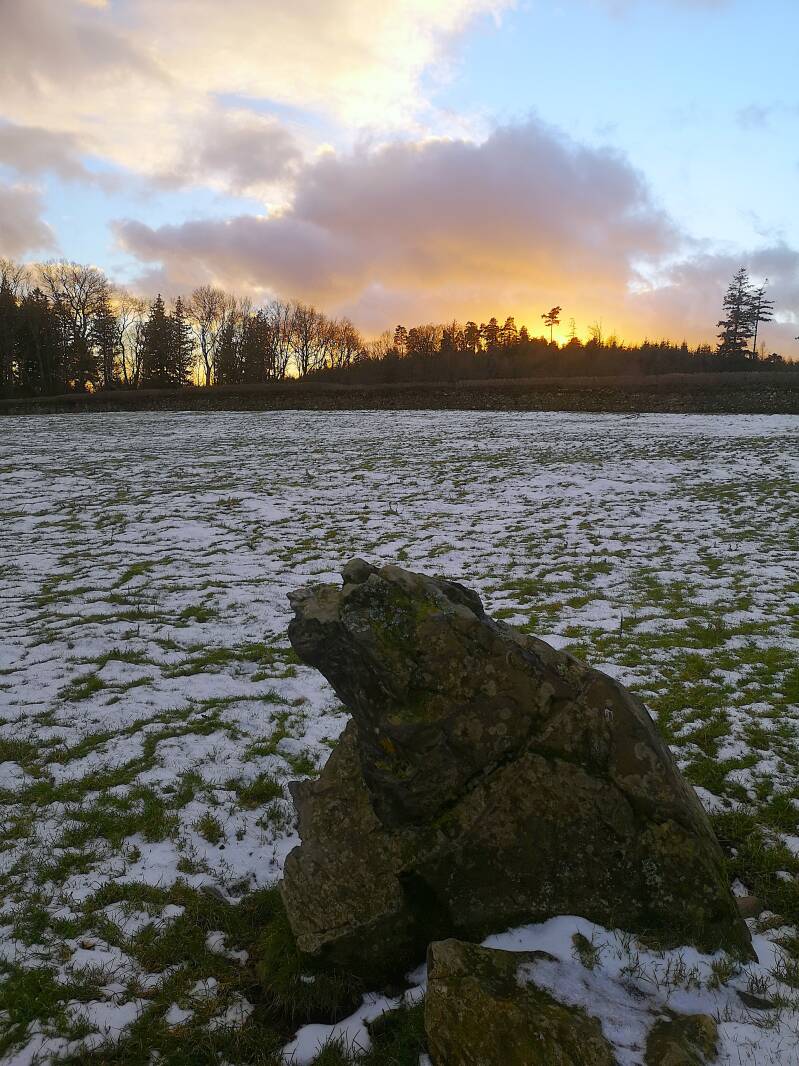
Whilst I have discussed some of these things before in other ways and details, including Toad Rock in Tunbridge Wells - I have not discussed the much-smaller Toad Stone before, that which is situated close to Cartmel. There is also The Toad Stone in Wiltshire by the way, which also has a very imposing and ancient looking appearance, and The Toad's Mouth in Derbyshire. I do not know when The Toad Stone near Cartmell received its name, but according to the National Monument Record there may have once been more stones, perhaps in a circle. When I visit The Toad Stone near Cartmell, I did notice some other stones slightly further down the hill from The Toad Stone, which could have been aligned with it in some way.
Photo below: the Toad Stone near Cartmel, outlined and silhouetted distinctively against the setting winter sun, taken some time in early 2023. Note how the rock is shaped like a toad, and how its head and neck are clearly visible. The other possible aligned stones I noticed are located heading towards the left and down through the fields, in the direction that the toad's head/nose is pointing. The stone is located not far from Holker Hall near Cartmel.
The Rent Stone is a different stone, and is seemingly a large granite erratic, situated in a field close to the village of Beetham in South Cumbria. Whilst this stone is not named after an entity with bird-like characteristics, to me, the megalith resembles the head of a giant thunderbird in some senses, although this is not visible from all angles. The stone was likely named The Rent Stone because people used to pay their rent to the lord of the land at this stone, according to local oral history. This could hold some truth, but I wonder if instead this idea of leaving money at the stone could hark back to a much earlier tradition of this stone being a kind of offering site, a place where people made offerings of bread etc to the stone and to the spirit being associated with it. This stone bares a similarity to some of the thunderstones in more eastern Cumbria, and, like some of those, The Rent Stone can look like a thunderbird's head from some angles, and like an elongated humanoid head from other angles. This relates also to something else I wrote very recently connected to "janus" figures, and to other things I have written before, and recently, about two-headed ancestors and such like, in several places. That these stones can appear like a long human head and a thunderbird head, at least to me, is also similar to how Ezekiel describes Kerubim as having four faces, and again in the Kerubim one of the faces is that of a bird, and one is of a human. Note that in my blog post published yesterday I also discuss possible ancient sites near Beetham.
Photo below: the Rent Stone near Beetham. Can you see the "bird-head" type shape to it, with the beak on the left side of the stone, as though the bird head is looking out over the valley to the left (not in view). As I have implied elsewhere, some of these stones also resemble elongated heads when viewed from a different angle, in this case the human face would be on the right side of the stone, with the elongated head being also the "beak" to the left. I have discussed much on this elsewhere recently, with different examples. Note also the eye-like shape on the left, if the eye shape is considered to be a part of the bird's head idea. Note that the Rent Stone is not by any means the most clear or obvious stone displaying these features in Cumbria, the "thunderstones" and others often display them much more clearly, although the Rent Stone does show these features. Note the horse in the background, which was very curious about me being there. I find often that when I visit ancient sites, once I start to pay attention to the archaeology and energies, and other features, the animals respond. Often they just stare at me, or come over and take an interest - it's as though they are guarding the site and are also curious about those who are aware of it. I also had a telepathic feeling that the entity of this stone was kind of indifferent towards people nowadays, that it had interacted with people in the past, that people used to make offerings of food, and that was what it was used to, but that after it interacted with me, it was open to the idea that maybe some humans would acknowledge it again in a more empathic way, as I felt that for a long time, it was honoured through leaving offerings, but that it wasn't really acknowledged. I had a feeling that it was curious about why I was there, and then after a while, the background "hum" I felt seemed to quieten down, and it carried on looking across the valley of the River Bela, a proud guardian, peaceful. This was not the most profound experience of telepathy, and I realise that for a lot of people the idea that a person can receive feelings about these places and even learn quite specific information - might seem far fetched. But, I think it's also important to be truthful from my perspective. I have discussed other aspects to this elsewhere recently, including in other blog posts on this website.

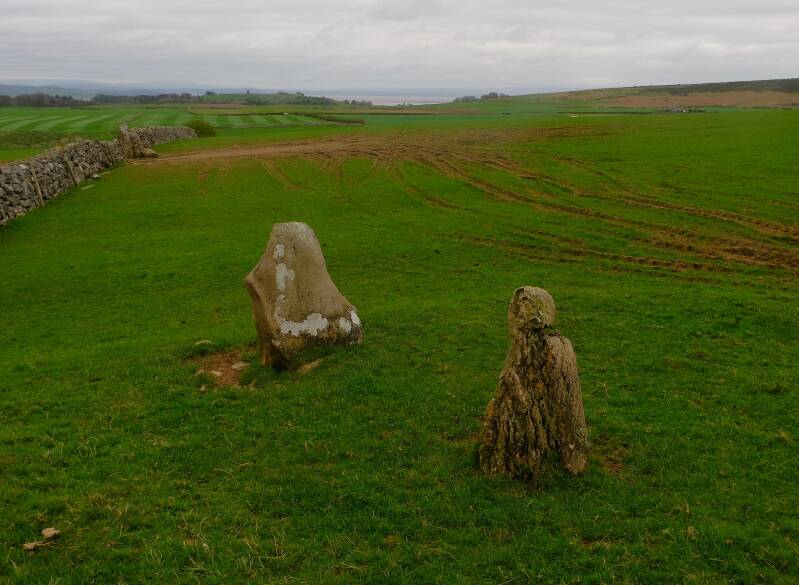
I have already discussed the Priapus Stone at Great Urswick before on this blog, but in addition, not far from Great Urswick, there is a prehistoric long barrow, with two standing stones, one of which possesses a very human-like shape. The site where this is located is utterly fascinating, and it consists of the Skelmore Heads "fort" (which may not actually be a fort), and the megalithic wall structures that surround it, at the edge of Skelmore Heads is an impressive long barrow, one of the few I know of in Northern England which is confirmed as a long barrow with clearly visible portal stones. One of these portal stones resembles what might be described as a cailleach or hag (I mean this is in the sacred sense of ancient goddess figures and not in any insulting way), a stone which is rough and textured and made of limestone, whilst the other is much smoother and I am less certain about what it represents.
Photo below: two, two standing stones, a part of the Great Urswick/Skelmore Heads Long Barrow, close to the edge of the Great Urswick/Skelmore Heads "Fort". These stones both have clearly defined shapes and forms, with the nearer of the two stones, on the right, made of limestone, having a shape that clearly resembles that of a miniature, elven adult human figure. To me, the stone on the right looks like a wise woman or possible a wise man in a cloak, with her arm, face and head clearly visible. The stone on the left, slightly further away, has a less-human like shape, but nevertheless has a distinctive shape. These two stones may have acted as a portal or entrance to this sacred long barrow at Skelmore Heads.
I hope that this article was an interested read - it is dedicated to these ancestral stone figures, and in particular to the ancestral spirit of the Rent Stone, but also to the others. Note that the four stones I describe in this article/blog post include the Toad Stone, the Rent Stone and the two portal stones at the Skelmore Heads Long Barrow, even if one of these stones is less easy to interpret in its shape than the other is.
Add comment
Comments