Note this article/blog posts contains some sensitive topics, so reader discretion is advised, and whilst the content of this article is not "adult" this article should not be read by those under the age of 18 due to the somewhat sensitive topics.
This article/blog post was written and published by Linden Alexander Pentecost, and was published on the 26th of February 2026, after an unrelated blog post was also published on this website a little earlier today. The two photos in this article were also taken by myself, the author, and were taken back in 2017. This article is unrelated to and separate from any and all of my other publications. The photos have also not been published before, and are also important. The photo descriptions in italics above the two photos also contain important information not in the main text. The main text also continues after the two photos and their descriptions.
No AI was used in this publication nor in any of my writings. This article/blog post was published in the UK, on this UK website, www.languages-of-linnunrata.co.uk and I the author am from the UK and am a resident of the UK. Tomorrow I will be publishing an unrelated article on one of my other websites, which will be unrelated to the article on this page and to all my other publications. Note that the way in which the topics of this article are ordered in the title does not correspond to their chronology within this article, nor does the title by any means give indication of all the topics discussed in this article. This article/blog post contains a total of 2682 words. The photos are located a fair way into this article/blog post.
Viking ship burials are rare in Britain, and on its surrounding islands. I know of no examples in Cumbria, for instance, despite that the media and other outlets continue to peddle this false idea that Cumbria is "Viking". Indeed, many in Cumbria in the past spoke Norse-like languages, but this does not directly equate them with Viking culture in the truest sense. The people in Cumbria, and elsewhere, who spoke Norse-like languages, were primarily farmers, with some hunting and fishing and other occupations also present. The Vikings, in the truest sense, were a warrior society, with a spirituality focused around this warrior culture, and of course around their ships and maritime culture - which is not directly equivalent to Norse spirituality and culture as a whole, nor to Icelandic saga traditions. Note, that there has been a suggestion recently of a possible Viking ship burial in Cumbria, but this has not been confirmed, and it in my opinion factually remains that the Norse and Viking presences in Cumbria were very different to those on the Isle of Man.
I have discussed other aspects of this before in many places, but essentially, I am of the belief that the people we class as "Vikings" in the truest sense, were actually more of a cult and inner, ancient culture, which existed within Norse society as a whole. The Vikings in the truest sense can be equated with the Sámi concept of the stallo, giant cannibal warriors who were in many cases enemies of the Sámi, and who could sometimes, in my opinion, even have been enemies of Norse-speaking cultures as a whole. The Norse as a cultural and linguistic grouping are distinct from the Vikings in the truest sense. The stallo in Sámi culture is also described as being akin to the berserker warriors, and so I believe that "Vikings" in this sense of the word, referred to these berserker cults within Norse society, the roots of whom can be traced back thousands of years earlier to the depictions of horned ancestor beings found in many parts of Scandinavia. I cannot stress enough, that these people were not representative of Norse society, they were their own thing, and whilst their magic and power was holy in its own ways, we can say for certain that this power became corrupted in later times.
These "berserker" cults, to my knowledge, seem not to have been present in Cumbria. But I believe it highly likely that they were present on the Isle of Man, or in Manx Gaelic: Ellan Vannin. The ship seems to be a central idea to these cults and ancient cultures who were not necessarily "Norse". We see the horned figures depicted in ancient Scandinavian petroglyphs, alongside long ships, and it seems to me that the idea of these horned figures seems particularly linked to the Viking ships, to the idea of "sea dragons" which the ships were intended to appear like, and this can also be seen in petroglyphs which go back thousands of years before the Vikings.
These Viking "berserker" cults and the stallos, also share many similarities to the Scythians, one of the main things being human sacrifice centred around the burials of chieftains. Some of the Scythian peoples would sacrifice horses, warriors and women, to be buried with a chieftain after his death. This is quite a crazy concept to understand, especially considering that these men and women, at least originally, likely would have been sacrificed consensually and willingly, which implies an understanding of morality which is to me, wrong, and which is so vastly different from how most other cultures viewed death. I say that to me this is wrong, because the idea and act of it is wrong, but I am not judging these people for making this choice in the past in their own cultural and religious context, which was likely extremely different from our own. Sacrificing animals is something which I also inherently dislike in different cultures, especially when the animals are not being eaten. What is perhaps most wrong about this to me though, is that it seems to always be centered around the elevation or worship of a particular individual. These chieftains were in other words considered so important as to have these elaborate, large-scale sacrificial rituals focused around their deaths. Perhaps, on some level, these chieftains were originally "not like" other humans, and the legends, depictions and other evidence, depicting the earliest leaders of these cults as giants, with horns, are suggestive I think that some of the leaders of these cults were viewed as having come from divine beings, or even having been divine, giant humans themselves. In Ukraine, where Scythian and Viking berserker cults were both present, there are also legends of horned humans, for instance.
By the time of the Vikings, these sacrificial rituals became even more unpleasant, with for example the writer Ibn Fadlan describing a horrific ritual centred around the burial of a Viking chieftain near the River Volga, again showing the connection between these sacrificial rituals and both the Scythians and berserker Viking cults in and around present day Ukraine. In the ritual described by Ibn Fadlan, ritualised killings take place, including that of a woman, which seem to be in no sense something that the participants agreed to in the cultural and religious context of the time. It is of course possible that this ritual was described by Ibn Fadlan as being worse than it was, but there is also little reason to think that Ibn Fadlan would have lied about what he witnessed. These "Vikings" that Ibn Fadlan described really have very little to do with Norse society as a whole, nor do they even seem to have much similarity to the Norse spirituality and creation stories attested in Icelandic literature. Which creates the obvious question, of, if these people who did these rituals did not represent the Norse, or even the Vikings as a whole, then who, and what exactly were they? These cults are defined I think by the use of kurgan mounds in the east, and of ship burials in the west, The "ships" were not merely physical objects, but were I think seen as akin to the serpents which used the sea to travel between this world and those that lie beyond, and fundamentally one gets the impression that the central architects of these cults were considered in some way, as having come from "divine realms" beyond the horizon, even if, by the Viking era, some of them were definitely not divine. We too often blame the Christians of Britain for giving the Vikings a bad name, but what if there is a reversal of the truth here? What if the Norse society and Norse-speaking peoples in Britain were actually different from the Vikings that terrified people?
Note, I am not suggesting that horned figures, Viking ships, serpents and ship burials are inherently evil in any sense. These things are utterly fascinating, and have connotations associated with fertility, magic, divine knowledge and the sacredness of the ocean. However, I think that the way that this ritual power was used did in later periods, become evil, which is to say this power, concentrated with peoples who later became associated with these horned figures, and who were later connected to the idea of ship burials. A woman was also found buried at the ship burial at Balladoole, but it is not certain if she was sacrificed as a part of the chieftain's burial, if she was for example a bride of the chieftain, or if she was buried there for other reasons. Whatever the case, it's strange and alien. But the ship burial site itself did not feel to me "negative", so I like to think that there was no real horror that took place there. If the woman was sacrificed, perhaps again it was wished by her in the religious and spiritual context of the time - not that I in any way think that this is morally okay nor in any sense right.
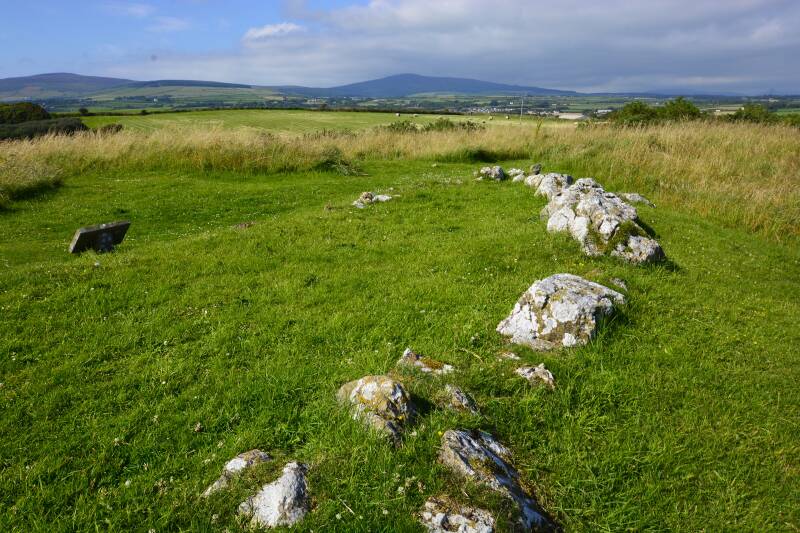
The ship itself at Balladoole was a wooden clinker-built vessel, of the type commonly known as a knǫrr in Old Icelandic literature. Along with the chieftain, animal remains, presumably sacrificed for a feast in this case, and along with the body of the woman, the knǫrr or knǫrr-like Viking ship was buried in a cairn, along with the aforementioned. The perimeter was marked out on the surface with large quartz rocks, which were placed in the formation of a ship. Although I have written quite a lot on things and spirits pertaining to quartz lately, I will note here that the Isle of Man contains quite a large number of sacred sites, which incorporate large amounts of quartz. Using quartz in this way is not unusual at sacred sites, especially considering I think the vibrational, electrical and more generally spiritual qualities of quartz (see my blog post regarding Hen Blas as well as other publications recently and earlier). But the Isle of Man does contain several sacred sites that have a large amount of quartz, including having several standing stones which are essentially entirely made out of quartz - which is a subject that I have not discussed before, but will in the future, it also relates to some of the things I discuss in my Hen Blas blog post.
In the case of the ship burial - was the quartz thought to somehow, help the spiritual essence of the ship, the chieftain, the woman and the animals to "move" over the divine sea to the otherworld? Do the quartz stones in the shape of a ship, just above the original wooden ship, help on a spiritual level, to transfer the ship and its occupants to the otherworld?
I have been to some other ship burials on Öland off the coast of Sweden (I discuss cup marks at one of these in detail and include a photo in a different blog post on this website). Even though the ship burials on Öland and elsewhere in Southern Sweden do not, to my knowledge, contain rocks made completely out of quartz, the rocks used no doubt do contain quartz, and so the same questions apply.
Photo below: a view of the Viking ship burial at Balladoole. Note the way in which the ship burial, marked by the large quartz stones in the shape of a ship, is pointing towards the Irish Sea on the horizon, the sea being in fact not far away from the ship burial. Note also the way in which the large quartz stones are shining in the sunlight, and the way in which the ship-shaped arrangement of quartz stones is upon a mound, i.e. cairn beneath the grass in this case. Could the quartz rocks visible be intended in some way to spiritually help transport the ship to the sea and to the horizon beyond?
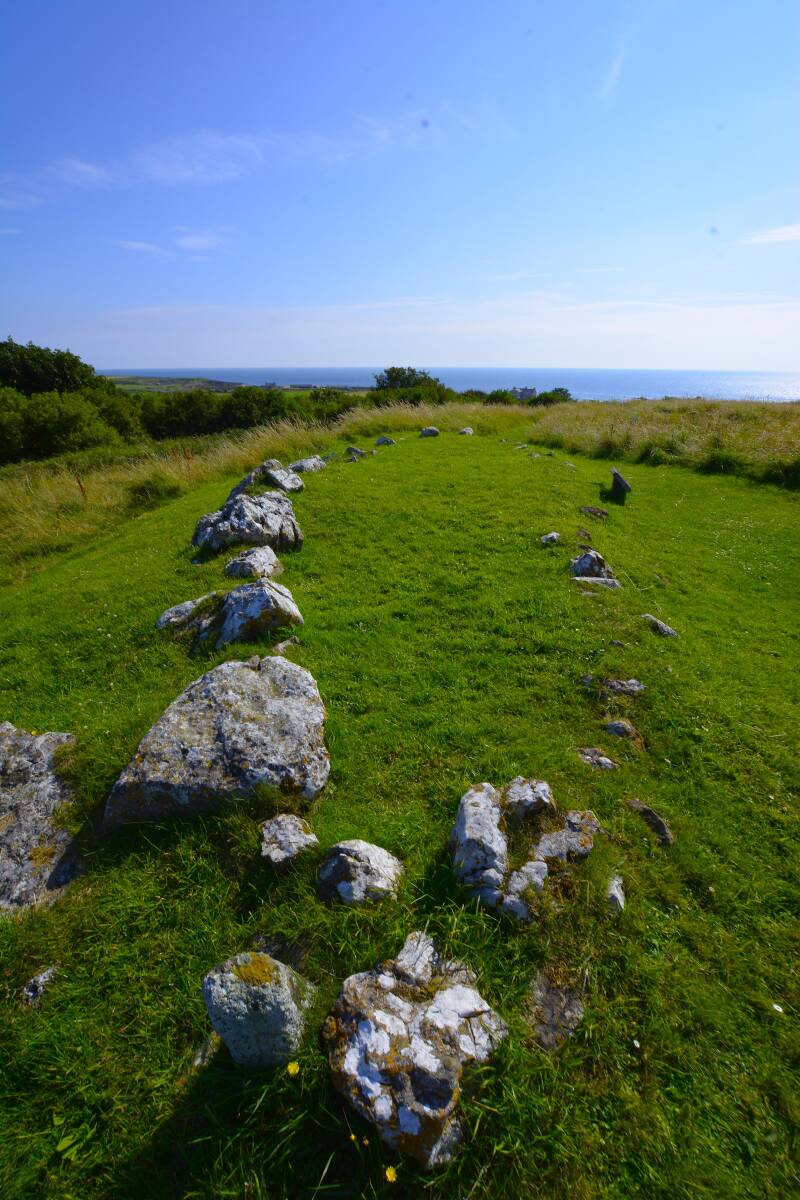
Photo below: another angle showing the Viking Ship Burial at Balladoole, with mountains in the distance. I wonder if in some way the placement of the ship and of the quartz stones align to other sacred ancient sites, and for example to mountains and other geographic features. The quartz boulders are again visible, especially on the right side of the ship (those on the left side are more visible in the photo above, but on the right). Note that in both photos the quartz seems to "glow" in the sunlight, although in places this is confused with the white lichens upon the rocks in places
Another thing which I would like to bring up here, regards the guardian protector deity of the Isle of Man, known as Manannan Mac Lir. I have written much about him before, but an important thing to note here is that he was said to have a ship known as Sguaba-Tuinne - "wave sweeper", and this ship is seemingly moved magically, and is without sails and without oars. I have noted in other publications the similarity between the name of Manannan Mac Lir's father, Lir, Icelandic hlýr a "cheek" or "prow of a boat", and Icelandic Hlér which is another name for the sea god Ægir. The connection between boats and Manannan Mac Lir is I think very relevant in a way which I have not discussed previously, especially given the presence of a Viking ship burial on the Isle of Man. Could it be that the gods Manannan, Lir and Ægir are connected to the original knowledge and wisdom of the "berserker" Viking cults, before they became sometimes corrupted later?
There is especially a similarity between the idea of Manannan's ship, which moves on its own accord with the will of Manannan, and this idea of Viking ship burials, and quartz stones, helping the now buried physical ship to "move" and to "be elevated" towards the otherworld, in a very similar vein to how Manannan's ship enables him to move between this world and the otherworld. I have discussed more on this elsewhere, including with regard to other divine figures like the Finns, and to the works of Tolkien. I have also discussed elsewhere a story, whether true or not, concerning a flying, glowing Viking ship seen in Liverpool some decades ago. Whatever the truth, this subject is very mystical, and I would highly recommend visiting the Viking ship burial at Balladoole. I was also recently re-watching a DVD which I received as a Christmas present back in 2010 along with some other DVDs on the Vikings, Disc Five being titled The Viking Ships. Some of the information in this documentary is in my opinion incorrect, but nevertheless, the documentary is fun to watch.
I hope that this article was an interesting read. I dedicate it to the lady who was buried at the Balladoole Viking ship burial, and to the others buried there, may their spirits be happy and be free. This article is also dedicated to Manannan Mac Lir and to all those I love. Whatever the history of this site, I think that by wishing it good wishes and wishing those buried there good wishes, it will continue to be a sacred and beautiful place.
Add comment
Comments