This blog post was written and published by Linden Alexander Pentecost, and was published on the 17th of November 2026. No AI was used in this publication; and like my other publications it was published in the UK. This publication is unrelated to and separate from any and all of my other publications, and the photos within this article have also never been published before. The 8 photos in this article were also taken by myself, the author of this article/blog post, except for one photo included, taken by my father, and included with his permission. This article/blog post contains a total of 2445 words.
If we look at the megalithic archaeology of Wales, Northern England and Ireland together, we will see commonalities - particularly in terms of stone circle sites, standing stones, stone rows, pairs of standing stones and certain cairn or enclosure sites that are in full or in part megalithic in nature. However, Wales and Ireland differ from Northern England in that Wales and Ireland they have passage tombs, chambered cairns and dolmens. There are only two widely accepted chambered cairn monuments in Northwestern England, both of which are located on Winter Hill in Lancashire.
But my own research and that of some others is implicative of widespread megalithic architecture in Northern England, particularly in what is now Cumbria. I have extensively documented many such potential sites in Cumbria, elsewhere in Northern England, and elsewhere, that have previously gone unnoticed or undocumented, and will discuss some others never before previously described - in this blog post.
I would argue that Cumbria is full of megalithic sites outside of those types commonly recognised, and some of these can I think be described as being certainly like chambered cairns and passage tombs - yet they are different. And I think there are I think plenty of other megalithic sites in Northern England, particularly in Cumbria, which do not fit into any of the aforementioned categories, which is in part I think the cause of why Cumbria's megalithic history has remained only partially or marginally documented.
Most of the sites shown here are unknown to archaeology, those which are unknown to archaeology are poorly understood or I think misinterpreted, or somewhat misunderstood. I do not claim to know the answers myself but feel I have a fair bit of insight and instinct about these places at this stage. I nevertheless think that these sites can be spiritually disorientating and potentially dangerous and people need to be respectful, and ideally spiritually "allowed" to enter them before visiting them. Please read my precautions at the end of this post about iron, but, generally if a person is "invited" in they will receive this as a strong positive or coherent/without friction type of feeling and or as a telepathic message. Additionally however the interaction needs to feel instinctively "right" in your gut, otherwise it is possible that a person is being deceived by a more dangerous ghost for example. Leaving an offering of tobacco or milk for example or nuts (depending on what feels instinctively right) should also be done before asking permission to enter any of these sites. I have not discussed any of the sites in this blog post in any other publication, nor have I shared the photos elsewhere. Despite that I do not know all of the locations of these sites exactly, as I visited them some while ago, the information I present is nevertheless important and relevant to researchers.
Another important thing I want to add is that I have been considering recently why exactly Cumbria and the other Celtic lands seem to have been in some ways "more" connected in terms of megalithic architecture during the Bronze Age. This does not contradict my previous work on these subjects but it shows a kind of reverse phenomena in the timescale. I have pondered whether or not a kind of religion emerged in the Bronze Age and that preeixsting pre-Celtic language connections would have continued and perhaps "reconnected" to some degree through a more Indo-European "Celtic" medium, but perhaps this was never completely the case in Cumbria. But I am beginning to think for sure that the builders of stone circles were in some cases a very different megalithic culture than those cultures connected to other megalithic sites, particularly when it comes to sites like Castlerigg. It is possible that Cumbria was the original centre of Stone Circles and that some of the earlier, more profoundly megalithic stone circles in Britain represent or connect to the language area we know as Cumbric and SW Brittonic, both of which were I think non-Indo-European languages by and large. This might explain the concept of something emerging from the "north" into Wales and out of Cumbria, which is interesting given that Cumbria was connected to Britain's early kings and was very central to them, and how Cumbria was in many ways the origin of some of some of the Welsh Arthurian and later Medieval Arthurian lore, even if the "older" Cumbrian forms may have been more centred on giants and more ancient times. Or - it is possible that the later, smaller Bronze Age stone circles like Castlerigg and those in Derbyshire and on Welsh mountaintops might represent something of an original "bardic" tradition and connect to what we might know as the Old Welsh language in some way. Perhaps all these possibilities are somewhat true.
Below are sites shown in photos and with important information about the sites above each photo.
Photo below: a section of the more recognised (but still not widely known) megalithic site close to a hamlet called Dalton and not far from Burton-in-Kendal, North of Carnforth. This site has been explained as being some kind of medieval or Iron Age animal enclosure, but the megalithic architecture of this site makes this explanation very unlikely in my opinion. The site bares many similarities to other sites in the region and to sites in North Yorkshire, and within this structure is a cist-like megalithic feature, similar to one I saw at Cowside in North Yorkshire (discussed in detail in earlier unrelated blog-posts on this website). Like other megalithic sites in the Farleton Fell area, this site does not easily fit into any category, hence the "animal enclosure" explanation. Other archaeologists have discussed some of the propped stones on Farleton Knott nearby, I have also discussed these in other publications and many other possible examples which I came across on the hill. The next photo shows another, to my knowledge, previous undiscussed site in this area, and very close to the site shown in the photo below. The coordinates of the site in the photo below are: 54.183349, -2.700798 . If visiting the site below please be aware of potentially dangerous livestock, the site is also sacred and should be respected.
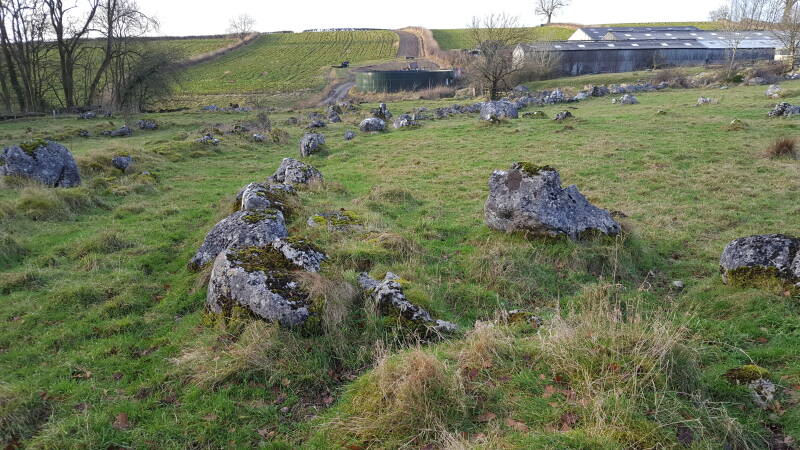
Photo below: another megalithic site not far from the site at Dalton near Farleton Fell shown in the photo above. The site below contains several areas of megalithic walls, perhaps connected to farming, yet them being merely field systems seems unlikely due the size of the rocks, of fair megalithic sizes, in these "walls" or stone row features. Again the site does not fit any category and seems unknown or undiscussed but does share similarities to the megalithic site shown in the photo above. The coordinates of the second site in the photo below are: 54.178054, -2.702491 . Again please be wary of livestock if visiting.
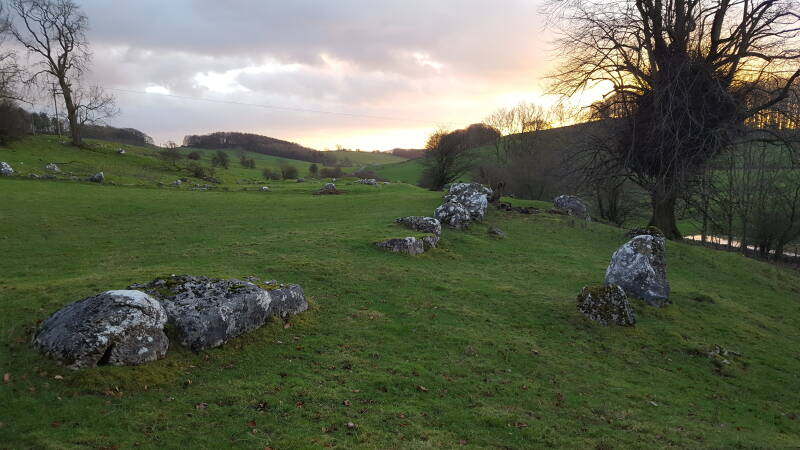
Photo below: a possible stone row type structure, yet another previously unpublished by me from the Arnside and Beetham area. This stone row is located at the coordinates of 54.208907, -2.803132 and is on private land. The feature could of course be a part of a medieval wall, but the size of the rocks and the fact that this monument seems isolated within the field, make me think that it could be another example of a stone row. Like most of the other sites I document, this site has not to my knowledge ever been documented or even noticed before as a possible prehistoric site - at least not for a long while.
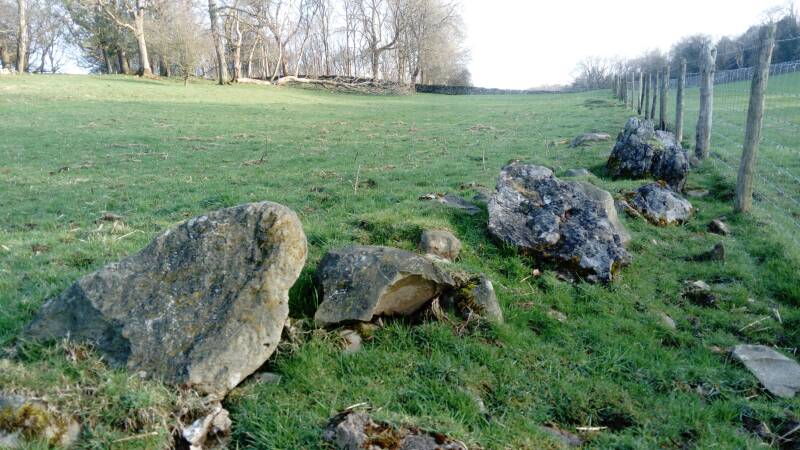
The site below shows some limestone megaliths in what appears to be a very old wall. This photo was taken in February 2019, on my birthday, somewhere between Elbolton Hill and the Linton Stepping Stones, near Elbolton in Yorkshire. The next day I went on a kind of date with a woman and it was lovely, and sometimes I have regretted rejecting her due to being hung up on someone else. She made me a beautiful dreamcatcher with shells and feminine colours, and we discussed ancient things, archaeology, non-conventional love and polyamory in connection to ancient cultures, and spirituality. I send her my blessings. I was 25 turning 26 and she was 28 I think. We went on our date in Bowness and Windermere and it was misty and atmospheric.
Elbolton hill is itself within the Barden Triangle zone of pronounced anomalous and ESP activity, with Elbolton Hill and Trollers Gill being well known paranormal zones in this area. I visited Elbolton Hill on the day I took the photo below, and indeed the atmosphere was heightened and strange, it felt as though me and the others I was with were walking in a thin, volatile zone of power. Ancient burials were found in caves on that hill, and I left small offerings of tobacco near the entrances to the caves (dangerous entrances) in honour of the ancestors. The two large and some smaller megalithic blocks visible in the wall in the photo below are I think evidence that this kind of architecture also existed around this part of Yorkshire, and may in some way connect to the ancient peoples who honoured Elbolton Hill as a sacred site. Even into recent times and into the present time the hill is both feared and deeply respected. My respect and empathy go to the beings connected to that hill and I ask that people take care when walking there, both to be respectful of paranormal phenomena and to leave when it feels necessary (or to not visit at all), and also to be careful of the open caves and mine shafts upon the hill.
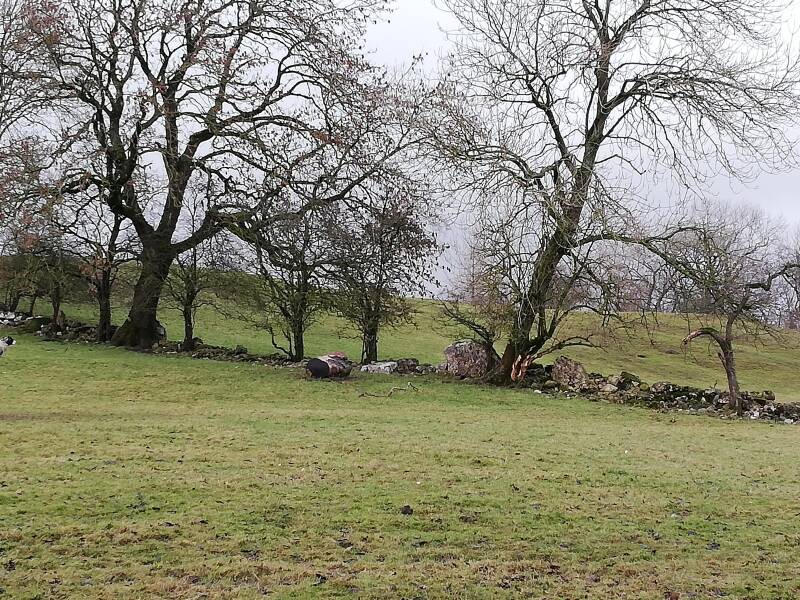
Photo below: a possible propped stone megalithic monument (centrre-right of the image), located close to the Kirkstone (the larger rock visible behind and to the left), located at the top of Kirkstone Pass in Cumbria. The Kirkstone itself resembles an elongated skull, and closely resembles a large similarly shaped megalithic at Dovedale Prehistoric enclosure, which is very nearby and in the valley below and into the distance. I have discussed the Dovedale Prehistoric Enclosure before on this blog in an unrelated post. I think it likely that both the propped stone in the foreground in the photo below, and the Kirkstone itself are a part of a sacred site and are examples of megalithic architecture.
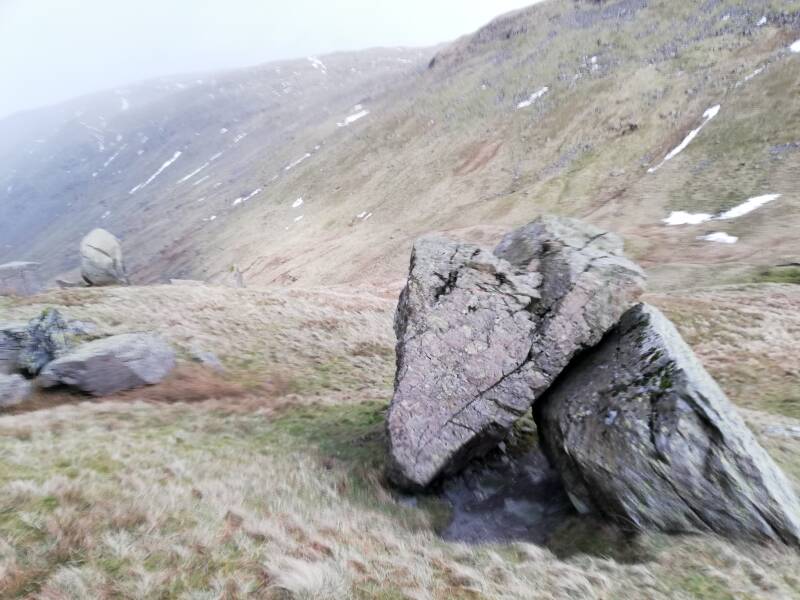
Photo below: a photo taken by my dad, of me and included here with his permission, at the Gunnerkeld Stone Circle north of Shap in Cumbria, I was 28 at the time the photo was taken. This is the famous stone circle that the mainline railway was rediverted in order to avoid, thankfully. Sadly a lot of the megalithic architecture closer to Shap was destroyed. Whilst, unlike the other sites, this site is well known, I included a photo of it here to show the shape of one of the large megaliths, and how it is another example of a megalith in Cumbria resembling the head of a giant bird. A Thunderbird, perhaps?
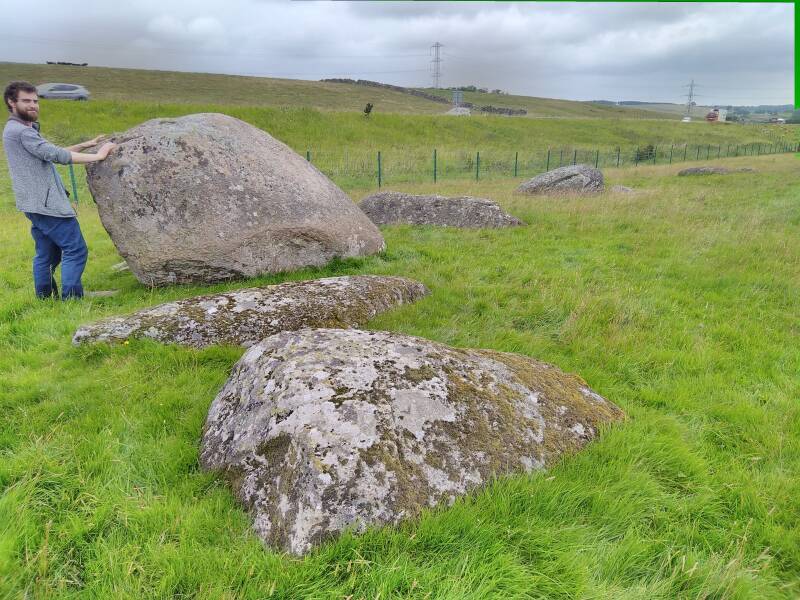
Photo below: the site shown in the photo below is a highly strange site located not far from Beetham in Cumbria, and is located at the coordinates of: 54.187442, -2.785523 and is accessible via a footpath from a Brackenthwaite Road. This site is really odd and hard to interpret. Behind where the photo was taken is evidence of quarrying, in the form of large piles of stones, which seem, presumably for quarrying, to have been blasted. Geologists would probably explain this site as a collapsed "tor", and I wonder if some of these areas of the tor (behind where the photo was taken) were quarried in the past and blasted away. But it is just really odd, because in some ways it seems like the rock was blasted apart but just left there. Very strange. Whilst some of the rock visible in the photo below is bedrock, there are as can be seen many sizeable megalithis, and one of them in particular (not visible in the photo below) has that typical dragon or bird-head shape found at many other Cumbrian megalithic sites. All in all, whilst the site does show clear evidence of having been quarried, some of the stones, whether erratics or not, are very large, do not show evidence of having been quarried, and they display some of the typical "shapes" of stones found at other megalithic sites in Cumbria, so the idea that the site shown below could be in-part a possible megalithic site from prehistoric times is I think possible.
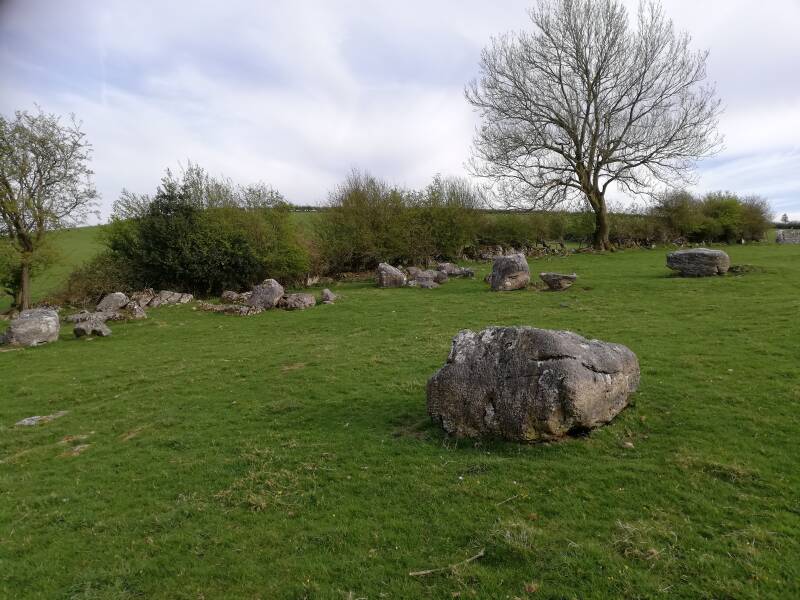
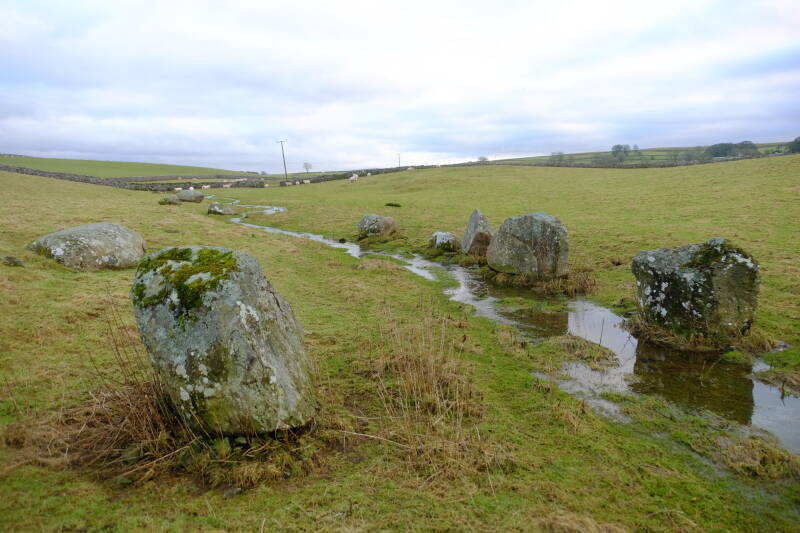
Photo below: the photo below shows an extremely interesting possible megalithic site close to Shap in Cumbria, and to my knowledge previously unrecorded. Like many other megalithic sites in Cumbria the positioning of the megaliths are connected to water, in this case to a small stream. This possible megalithic site is located down the road from the Castlehow Scar Thunderstone, if heading downhill, and this site photographed below is in a field visible to the left as if heading downhill, but I cannot pinpoint the exact coordinates. Sceptics might explain this site as natural glacial erratics collecting in a small hollow, but the rocks are positioned in such a way around the stream that make their placement seem unlikely to be natural, plus, given the huge number of other megalithic sites in the area, it is perhaps not unreasonable that the site in the photo below might be another.
I hope that this blog post was an interesting read. Please respect these ancient sites and be conscious of how many consider them to be potentially volatile spiritual places where somebody technically has to be "invited in" in order to enter them. Even when entering please take great care and research the folklore and later articles about the use of iron for protection against potentially disruptive forces. This blog post is dedicated to the ancestors of these places.
Add comment
Comments